
CoaXPress
CoaXPress is an asymmetric high-speed point-to-point serial communication digital interface standard. This standard allows devices (such as digital cameras) to connect to hosts (such as data acquisition devices in personal computers) via a single coaxial cable to transfer data at speeds of up to 6.25 gigabits per second. Because CoaXPress has the ability to transmit image data and metadata through multiple channels, devices don't have to be individual cameras; they can also be interface devices that connect data between digital cameras.
For information transfer from the host to the device, there's an "uplink" with a transmission speed of 20 megabits per second, which can control and configure the data. For higher transmission speeds, multiple links can be overlaid to provide several times the bandwidth of a single coaxial cable. Power can also be provided through the cable with a voltage of 24 volts and a power of 13 watts per cable.
CoaXPress technology was jointly developed by Adimec and EqcoLogic companies and has gained worldwide recognition. Developers subsequently formed the CoaXPress Association to promote the CoaXPress interface as a standard interface. The current members of this association include:
- Active Silicon – Acquisition card
- Adimec – Camera
- Component Express – Cables
- EqcoLogic – Chipsets
- AVAL DATA - Acquisition card
- NED - Line scan camera
Product Advantages
In machine vision applications, the relentless pursuit of speed necessitates faster cameras, leading to the development of new generations of sensors. These new CMOS sensors can capture high-resolution images at extremely high speeds, significantly increasing data transfer rates. This data volume far exceeds the capacity of traditional interfaces such as Camera Link and GigE Vision.
The CoaXPress standard can support the growing bandwidth demands over the next decade while also meeting many additional requirements, such as larger cables, higher cable reliability and flexibility, real-time behavior, and cost-effectiveness. The adoption of standard coaxial cables and bandwidth makes CoaXPress not only of interest in the machine vision application field but also highly suitable for applications in the medical and security markets, which widely use coaxial cables. By using the same coaxial cables, CoaXPress can smoothly upgrade analog video to digital video.
Features
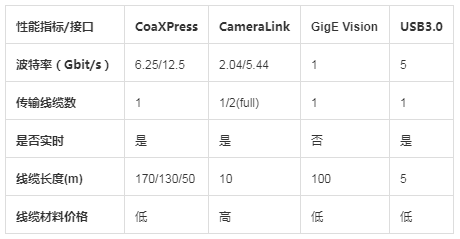
- Higher data throughput: Single cable up to 6.25 Gbit/s, four cables up to 25 Gbit/s.
- Longer transmission distances: Over 100 meters (without using hubs and repeaters).
- Optional transmission distances and throughput: From 50 m @ 6.25 Gbit/s to 170 m @ 1.25 Gbit/s.
- Achieves low-latency real-time data transmission.
- Stable cable materials, compatible with standard coaxial cables such as RG59 and RG6.
- Easy integration: Video transmission, serial communication control, and power supply can be achieved on a single cable.
- Low-cost cable materials.
- Hot-plug support.
Technical Advantages
Here's a comparison of the CoaXPress interface with several other interface technologies:
Standardization Status
In the selection of interface standards for high-performance, high-speed, long-distance imaging system applications, CoaXPress quickly emerged as a top competitor. One major reason for its rapid market acceptance is that CoaXPress cleverly and timely caters to the latest developments in camera technology. The Japan Industrial Imaging Association (JIIA), which advocates for the adoption of the CoaXPress high-speed digital interface standard in the imaging field, claims that support from the Automated Imaging Association (AIA) and the European Machine Vision Association (EMVA) for CoaXPress, based on the G3 protocol, has become a world standard. Support from AIA and EMVA is a natural result of the smooth approval of this standard, as per the CoaXPress standard "JIIA NIF-001-2010" established on December 6, 2010.
CoaXPress 2.0, with increased transmission rates and further standardization upgrades, was launched last year, bringing new developments and opportunities for high-speed camera shooting and image transmission.
FALenses Technology specializes in providing machine vision core hardware. You can go to the official website of FALenses Technology at https://www.falenses.com/ for more information.