
Field of View (FOV) and Angle of View
Human Field of View
"Field of view," also known as "visual field," refers to the spatial range visible when the eyes fixate on a point (or through an instrument). The field of view of both eyes is greater than that of a single eye. The size of the field of view varies for different colors, with green having the smallest field of view, followed by red, blue, and white. This variation primarily results from the differing concentrations of cone cells sensitive to different wavelengths of light and the smaller size of the retina.
The horizontal field of view for human eyes is approximately within a range of about 60° on each side for both eyes, while the most sensitive vision occurs within a range of 1° on each side of the standard line of sight. The standard line of sight for a single eye extends from 94° to 104° on each side.
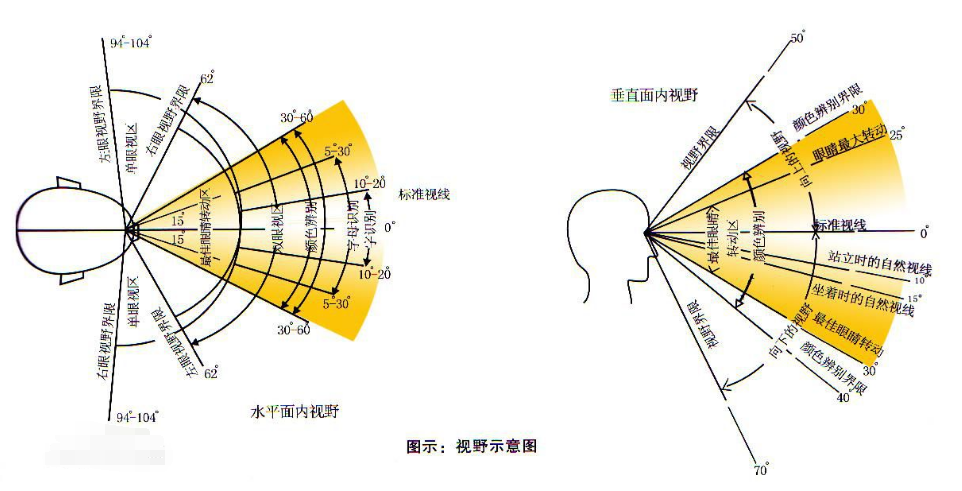
In the vertical plane, the maximum field of view extends to about 70° below the standard line of sight, with the color discrimination boundary lying approximately 30° above and 40° below the standard line of sight. In practical terms, natural eye level is typically below the standard line of sight by 10° when standing, 15° when sitting, and 30° when in a relaxed standing or sitting position. The optimal viewing area for display items lies below 30° below the standard line of sight.
Angle of View
In optical engineering, the angle of view, also known as the field of view, determines the range of vision for optical instruments. The angle of view can also be represented by FOV and is related to the focal length as follows: h = f*tan[Theta]; where h represents image height, EFL is the effective focal length, and FOV is the angle of view.
-
In optical instruments, the angle formed by the maximum range of two edges through which an object or image can pass, with the lens of the optical instrument as the vertex, is called the angle of view.
-
In display systems, the angle formed between the edge of the display and the line connecting the observation point (eye) is the angle of view.
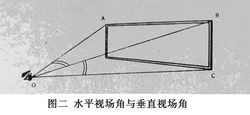
The angle of view is divided into object-side and image-side angles of view. In most optical devices, the object-side angle of view, measured as the diameter of the imaged object, is of primary concern. For example, telescopes and microscopes typically measure the angle of view based on the diameter of the imaged object, while cameras and camcorders calculate the angle of view based on the diagonal diameter of the rectangular image sensor.
The relationship between the angle of view and focal length is generally such that a larger angle of view corresponds to a shorter focal length. For example, a telephoto lens with a narrow field of view is typically less than 40°, whereas a lens with a focal length of 2.5 mm has an angle of view of about 45°. A lens with a focal length of 5.0 mm has an angle of view of about 23°, while a lens with a focal length of 7.5 mm has an angle of view of about 14°. Lenses with focal lengths of 10 mm and 15 mm have angles of view of about 12° and 8°, respectively.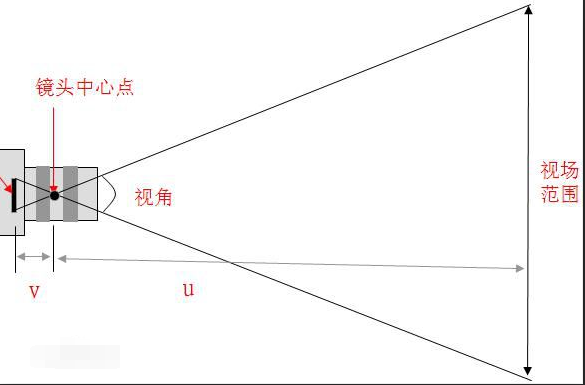
Camera lenses can be classified based on their angle of view:
- Standard lens: with an angle of view of about 45 degrees, suitable for a wide range of applications.
- Telephoto lens: with an angle of view of less than 40 degrees, suitable for long-distance photography.
- Wide-angle lens: with an angle of view of over 60 degrees, providing a larger observation range but with distortion in close-up images.
- Ultra-wide-angle lens: a type of wide-angle lens with an extremely broad field of view (80–110 degrees).
- Fisheye lens: a lens with an angle of view approaching or equal to 180 degrees, known for its extreme wide-angle perspective.
FALenses Technology specializes in providing machine vision core hardware. You can go to the official website of FALenses Technology at https://www.falenses.com/ for more information.