
Generation and Correction of Image Distortion
What is Image Distortion?
Distortion, often mentioned as a parameter in optical systems, is one of the important factors limiting the accuracy of optical measurements. It refers to the degree of distortion of the image formed by an optical system relative to the object itself, causing deformation of the image without affecting its clarity.
For an ideal optical system, the magnification is constant on a pair of conjugate object and image planes. However, for practical optical systems, this property holds true only when the field of view is small. When the field of view is large or very large, the magnification of the image varies with the field of view, causing the image to lose similarity to the object. This imaging defect that causes image deformation is called distortion. Distortion is defined as the difference between the actual image height and the ideal image height, and is often expressed as a percentage of the ideal image height, known as relative distortion.
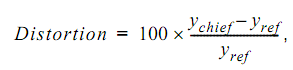
Common Types of Distortion:
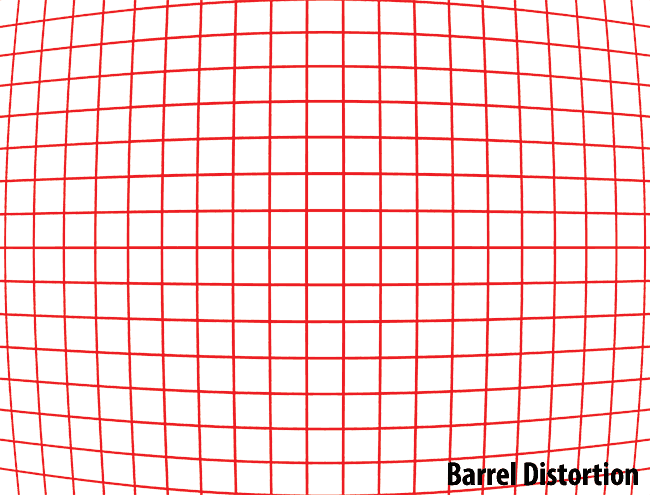
Barrel Distortion: In barrel distortion, the magnification of the image decreases with the distance from the optical axis, resulting in the image being mapped around a sphere (or barrel). Fisheye lenses have a hemispherical field of view, and they utilize this deformation to map an infinitely wide object plane onto a finite image area. In zoom lenses, barrel distortion occurs in the middle of the lens's focal length range, and it is most severe at the wide-angle end of that range.
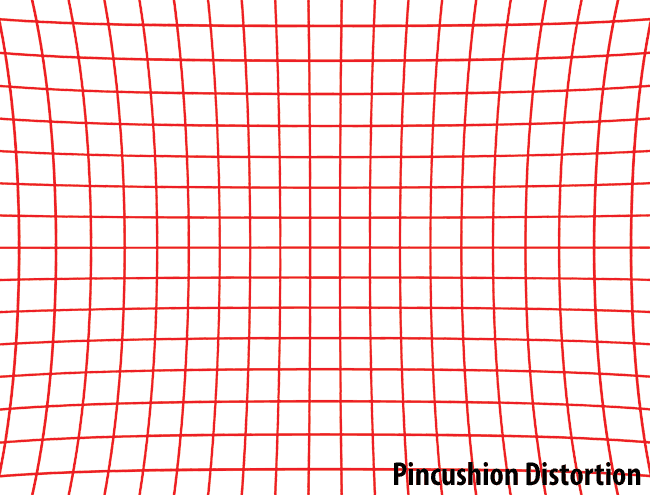
Pincushion Distortion: In pincushion distortion, the magnification of the image increases with the distance from the optical axis. The visible effect is that lines not passing through the image center bend inwardly, toward the image center.
Image Distortion in Machine Vision
Impact of Image Distortion:
FALenses technology believes that many inspection applications require highly accurate measurements. Although software algorithms with sub-pixel interpolation can provide very fine measurement results, they cannot provide accurate or repeatable results if the created images have any distortion. Therefore, selecting appropriate optical devices is crucial to the success of a measurement system. Fortunately, using some optical principles, it is possible to use telecentric lenses, which can overcome problems with changes in object position, differences in object height, and other issues that may cause incorrect image information during software processing. Therefore, the reasonable use of telecentric lenses can solve the problem of image distortion well.
The Importance of Telecentricity:
Perspective error, also known as parallax, is part of our daily experience. In fact, parallax is what makes the brain interpret the 3D world. Objects closer to us appear relatively larger, a simple example being when someone stands by a set of railroad tracks, with both tracks appearing parallel as they are close together. When looking toward the horizon, these parallel tracks seem to converge somewhere far away. We know they don't actually converge at a distance; otherwise, the train would fly off the tracks, but this perceptual way of seeing is crucial. This phenomenon also exists in conventional imaging systems, where the perceived size of objects (their magnification) varies with their distance from the lens. Telecentric lenses can correct this optically, so within the range defined by the lens, objects maintain the same perceived size regardless of distance. In the example of the railroad tracks, a telecentric lens would make the tracks appear to be the same distance apart, whether they are in front of the lens or on the horizon.
Advantages of Telecentric Lenses:
For many applications, telecentricity is required because it provides an almost constant magnification within a certain working distance range, effectively eliminating perspective error. This means that object movement does not affect the image magnification. In optical systems with telecentric lenses, objects moving closer or farther from the lens do not cause the image to become larger or smaller. Additionally, objects with depth ranges along the optical axis do not appear tilted. For example, a cylindrical object whose axis is parallel to the optical axis appears circular in the image plane of a telecentric lens. In non-telecentric lenses, the same object appears elliptical on top and visible on the side. It is worth noting that in optical systems with telecentric lenses, focusing or intentionally defocusing the image plane does not change the image size. Another advantage of telecentric lenses is that they can provide extremely uniform illumination of the image plane. Telecentric lenses can provide some of the lowest levels of distortion (distortion) available on the market today, greatly enhancing their ability to provide reliable vision systems. As the demand for machine vision systems continues to grow, selecting the right optical components is more important than ever. The optical system is a crucial part of adjusting the image for analysis and should not be overlooked. Whenever critical measurements are required, consideration should be given to using telecentric lenses to produce systems that truly deliver the desired results.
FALenses Technology specializes in providing machine vision core hardware. You can go to the official website of FALenses Technology at https://www.falenses.com/ for more information.