
Relative Illuminance of Industrial Lenses
First, let's distinguish between two concepts: illuminance and relative illuminance of lenses.
- Illuminance of a lens refers to the brightness at the lens's optical axis, which is the imaging center, and it depends on the F-value (aperture value).
- Relative illuminance of a lens refers to the ratio of the illuminance at various field positions on the image plane to the illuminance at the center field, indicating the phenomenon of reduced brightness in peripheral fields due to vignetting effects caused by the cosine to the fourth power law.
Today, we'll mainly discuss the primary factors affecting the relative illuminance of industrial lenses:
-
Cosine to the Fourth Power Law
Parallel incident light rays with the lens's optical axis converge at the imaging center. Let's assume the illuminance of the image point on this axis is E0'. For oblique light rays that are not parallel to the optical axis, forming a field angle ω on the object side, the illuminance on the image plane Eω' is calculated as:
��’=�0’⋅cos4(�)
The brightness of the image formed by oblique light rays is directly proportional to the cosine to the fourth power of this oblique angle. From this formula, it can be concluded that the closer to the edge compared to the imaging center, the smaller the illuminance on the image plane. Therefore, the phenomenon of bright center and dark edges occurs, which is determined by objective principles and, like distortion, can only be minimized but not eliminated.
The relative illuminance of the image plane depends on the field angle on the object side. In finite conjugate systems, improving relative illuminance can be achieved by designing the entrance pupil away from the object surface. For infinite conjugate systems (telecentric optical systems), the object-side field angle is generally given a fixed value during design, so the relative illuminance is essentially fixed. This is also the main reason why the relative illuminance of telecentric lenses is better than that of general FA lenses.
-
Vignetting
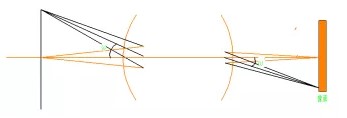
Vignetting, in simple terms, is the phenomenon where imaging beams emitted by off-axis object points are intercepted. Vignetting to some extent can improve the imaging quality of off-axis object points but will weaken the illuminance of corresponding points.
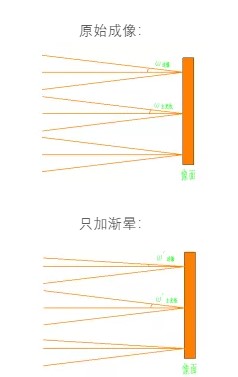
Let's visually understand the effect of vignetting on relative illuminance from several images:
[Images]
From these images, it can be observed that adding vignetting only reduces the angle of the edge rays (ω' edge < ω edge), while the angle of the central rays remains unchanged (ω' main ray = ω main ray). Therefore, the illuminance at the lens edges decreases while the central illuminance remains unchanged, resulting in a decrease in relative illuminance.
Based on vignetting, it can be inferred that increasing the F-number, simultaneously reducing the angles of the edge rays and central rays, will decrease both the edge and central illuminance, thus increasing the relative illuminance. However, increasing the F-number to improve relative illuminance is rarely used in practice because although it ensures relative illuminance, it lowers the central illuminance of the lens, making the overall image brightness very dim.
Considering the factors affecting relative illuminance mentioned above, if you want to obtain an image with relatively uniform illuminance, you can choose a small field-of-view industrial lens. If you have higher requirements for uniformity, then a telecentric lens will be your best choice.
FALenses Technology specializes in providing machine vision core hardware. You can go to the official website of FALenses Technology at https://www.falenses.com/ for more information.