
Spherical and Aspherical Lens in Industrial Lens Design
The concepts of spherical and aspherical primarily refer to the geometric shape of lens elements, namely spherical and non-spherical lens elements. Their geometric differences determine differences in the direction of refraction for parallel incident light rays, thus affecting the imaging performance of industrial lenses.
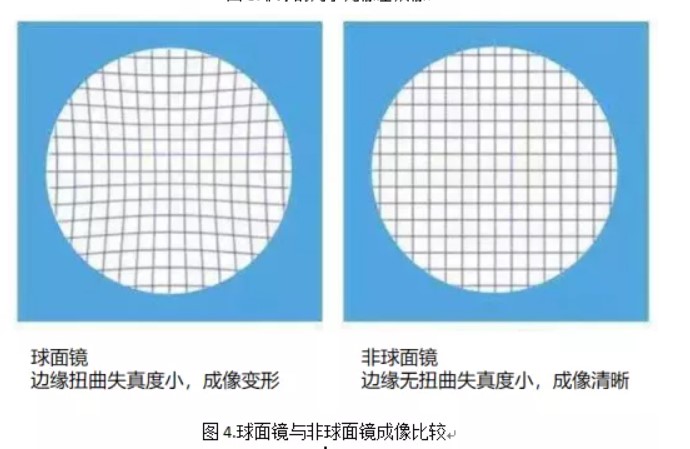
Comparison of Spherical and Aspherical Imaging
-
Spherical Lens Elements
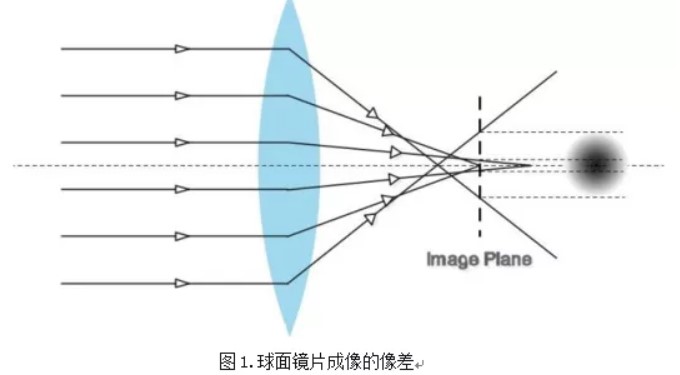
Spherical lens elements have a curvature resembling a sphere, with their cross-section also being arc-shaped. When light rays of different wavelengths enter the lens parallel to the optical axis and strike different positions on the lens, they cannot converge to a single point on the image plane, leading to imaging aberrations (as shown in Figure 1).
This affects the imaging performance of industrial lenses, causing phenomena such as decreased clarity and distortion. Generally, ordinary lenses are composed of spherical lens elements. To address this imaging problem, aberrations can be corrected by adding more lens elements, but this may also have adverse effects, further weakening imaging performance. Additional lens elements not only increase the chances of light reflection within the lens barrel, leading to glare phenomena, but also add to the volume and weight of the lens. Spherical lenses perform relatively well in the central region but rapidly degrade in imaging quality in the off-axis region. This degradation is known as aberration, and among the five primary aberrations, four are related to spherical aberration. Therefore, spherical aberration must be carefully balanced in industrial lens design.
-
Aspherical Lens Elements
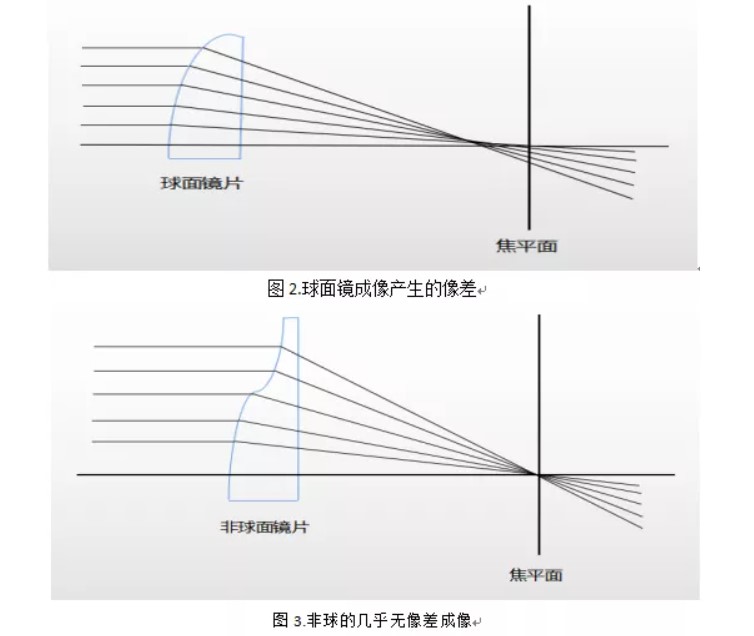
There are various methods to balance spherical aberration, such as using multiple different concave and convex spherical lens elements to cancel out aberrations between them. However, since spherical aberration results from the inability of spherical surfaces to achieve perfect imaging, using a surface capable of perfect imaging would suffice. Thus, non-spherical lenses, or aspherical lenses, came into being.
However, as mentioned earlier, aberrations can only be balanced, and no system can achieve perfect aberration-free imaging across all spaces. Therefore, different lenses and shapes of non-spherical surfaces need to be combined according to the specific application to minimize various aberrations. Using non-spherical lens elements can reduce aberrations, decrease the number of lens elements used, and provide greater design flexibility.
Selection between Spherical and Aspherical
The differences in design between spherical and non-spherical lenses have been discussed above, but the main factor influencing the designer's choice is cost. Spherical lenses are easier to manufacture in bulk and thus have lower costs, while non-spherical lenses are difficult to manufacture, require high process requirements, and are more expensive. However, cost cannot be generalized. Non-spherical lenses allow optical designers to use fewer optical elements than traditional spherical elements to correct aberrations, as they provide more aberration correction than multiple surfaces. For example, a zoom industrial lens typically using ten or more lens elements can be replaced by one or two aspherical lenses, achieving the same or better optical performance while reducing production costs and system size.
Using more optical elements in an optical system may have negative impacts on optical and mechanical parameters, leading to more expensive mechanical tolerances, additional calibration steps, and more demands for anti-reflection coatings. All of these outcomes ultimately reduce the overall usability of the system. Therefore, whether to introduce non-spherical lenses in system design depends on the actual design requirements and the balance between the considerations of the two options.
FALenses Technology specializes in providing machine vision core hardware. You can go to the official website of FALenses Technology at https://www.falenses.com/ for more information.