
How to Choose Telecentric Lenses Based on Field of View
The field of view refers to the range of objects visible after using a camera. First, let's understand the calculation method for the field of view.
The size of the field of view is usually related to the effective area and magnification of the camera. Generally, knowing any two of these can help in selection. Different camera sensor sizes lead to different fields of view. Typically, the field of view can be calculated using the following formula:
Once we have the field of view, we can find lenses that meet the requirements. Typically, for telecentric lenses and object-side telecentric lenses, the maximum field of view remains the same. We only need to determine the appropriate magnification after using the camera.
For example, consider the OTL11.5-20-65C from Light Tiger Vision, where the magnification, camera sensor size, and working distance are clearly indicated. If the requirement is a field of view of about 5.5mm due to positional considerations, we can determine if the lens satisfies this requirement by plugging the field of view and sensor size into formula (1). For example, if the camera has a 2/3” sensor, and a 2x telecentric lens is used, the calculated magnification would be approximately 2.09. As the 2x field of view can reach 5.75mm, it meets the requirement. However, customer requirements vary, so there are options like 0.5x, 0.8x, 1x magnifications, etc. Additionally, for different needs, there are high-resolution and large-depth-of-field types available!
What about when the lens image plane differs from the sensor size?
First Scenario: Lens Image Plane Larger Than Sensor
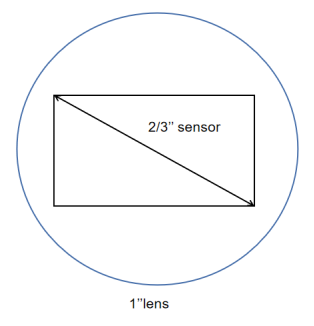
For example, let's choose the TTL18.5-45-65C lens with an image plane size of 18.5. The magnification is 0.411, but the camera sensor is 11.5. Since the camera is the imaging device, its field of view equals the camera sensor size divided by the magnification, i.e., 11.5/0.411 = 27.98mm, while the lens's field of view can reach 45mm. Therefore, as shown in Figure 1, some of the lens's field of view will be wasted.
Second Scenario: Lens Image Plane Smaller Than Sensor
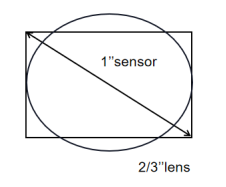
For example, consider using the TTL11.5-45-65C with a magnification of 0.256. If a 1” camera is used, plugging into formula (1) gives a maximum field of view of 18.5/0.256 = 72.27mm. However, as shown in Figure 2, there will be blind spots around the edges of the sensor, resulting in dark corners in the image.
Third Scenario: Optimal Lens and Sensor Match
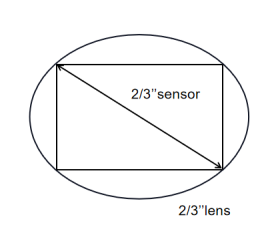
Therefore, when selecting a lens, it's essential to match it with the camera. Ideally, the lens's sensor size should be slightly larger than the sensor's diagonal size, as shown in Figure 3. This way, lens performance isn't wasted, and image quality is improved.
Of course, lens selection involves considering factors like resolution and working distance as well. For more details, refer to past content on "How to Select Parameters for Telecentric Lenses."
FALenses Technology specializes in providing machine vision core hardware. You can go to the official website of FALenses Technology at https://www.falenses.com/ for more information.