MTF (Modulation Transfer Function) is one of the important parameters used in the field of optics to describe the imaging quality of optical systems. It quantitatively describes the ability of an optical system to transfer spatial signals of different frequencies, reflecting the imaging capability of the optical system. In image processing, MTF is often used to evaluate the sharpness and resolution of images.
Resolution refers to the smallest details or spacings that an optical system can resolve when imaging. In optical systems, resolution is usually expressed in line pairs per millimeter (lp/mm) or line pairs per picture height (lp/ph), reflecting the system's ability to resolve image details. Higher resolution means that the optical system can present smaller-sized target objects or finer details clearly.
Contrast refers to the degree of brightness difference between different regions in an image. In optical systems, contrast determines the clarity of different parts of the image and the sharpness of edges. High contrast means that there is a significant brightness difference between different parts of the image, resulting in a clearer and more vivid image. Low contrast means that there is a small brightness difference between different parts of the image, resulting in a blurry and unclear image.
There is a close relationship between MTF, resolution, and contrast. The MTF curve describes the contrast transfer capability of an optical system at different spatial frequencies, thus reflecting the system's resolution characteristics. Therefore, the MTF curve is an important tool for evaluating the imaging quality, resolution, and contrast of optical systems.
Resolution
The resolution of an optical system refers to the minimum distance at which details in the "object" can be distinguished in the resulting "image" after passing through the optical system. Typically, we use the minimum distance between two resolved points in the optical system to represent resolution. For black-and-white patterns (fluorescent samples are actually a type of black-and-white pattern), this resolution can also be represented by the number of black-and-white lines that can be resolved within a unit distance, with wider intervals between black-and-white stripes being easier to distinguish. See the illustration below.
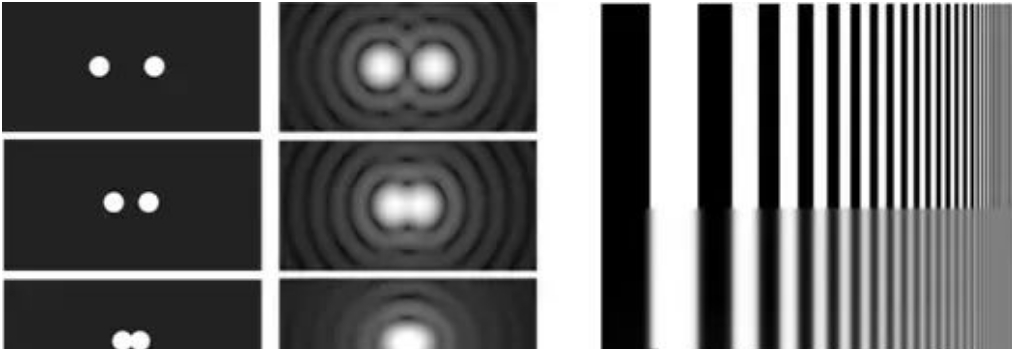
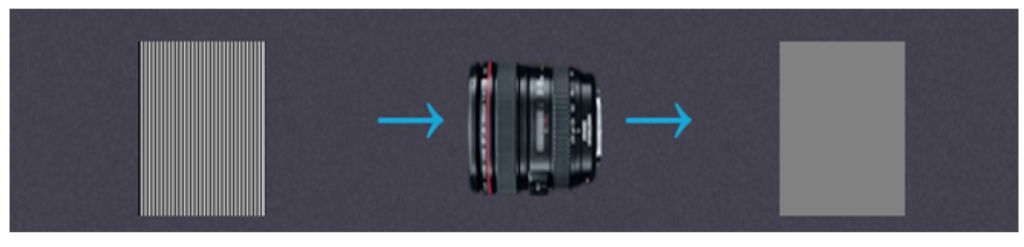
However, resolution only describes how much detail a lens can capture and does not necessarily describe the quality of the captured details.
At this point, we also need to consider another factor contributing to the quality and clarity of digital images: contrast.
Contrast
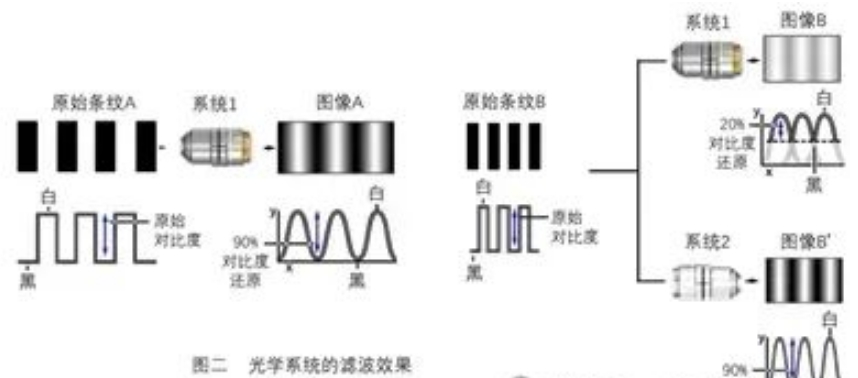
Diffraction and aberrations in optical systems cause "distortion" in the process from "object" to "image".
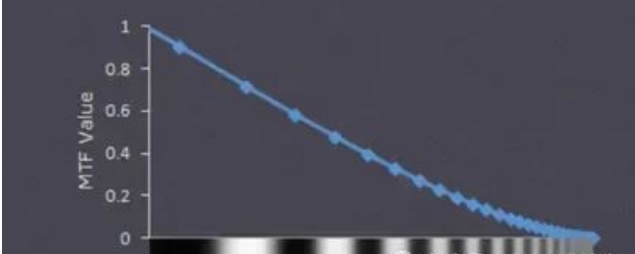
As shown in the above figure, an optical system can be regarded as a low-pass filter in space, allowing only spatial frequency signals within a certain bandwidth range to pass through. In simpler terms, it weakens the sharpness and contrast of transitions from "black" to "white," making them smooth and blurry. After passing through the lens, the original 100% contrast between black and white is now at most 90%, so for a lens with a given density, its MTF is only 90%.
Therefore, for two lenses with the same resolution, the apparent quality of the image mainly depends on the degree to which each lens maintains contrast as these lines narrow.

MTF (Modulation Transfer Function)
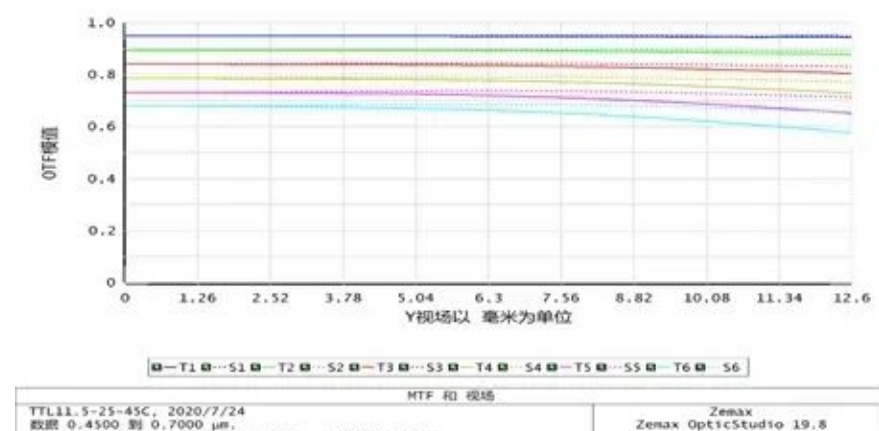
In order to make fair comparisons between lenses, we need to establish a method for quantifying the loss of image quality. The Modulation Transfer Function (MTF) quantifies the degree to which changes in brightness in an object area are preserved through the camera lens. It provides a quantitative description of the lens's resolving power. The MTF curve reflects both the resolution and contrast of the lens.
The ordinate of the MTF curve graph represents contrast, which is calculated as follows:
Contrast = (Maximum luminance - Minimum luminance) / (Maximum luminance + Minimum luminance).
An MTF of 1.0 indicates perfect contrast preservation, while values less than this indicate increasing loss of contrast until the MTF reaches 0, at which point line pairs can no longer be distinguished. Under the same F/# and operating wavelength, any optical lens has a limiting curve that depends only on the lens aperture, regardless of the number of camera pixels, known as the diffraction limit.
Ideal Lens MTF Curve
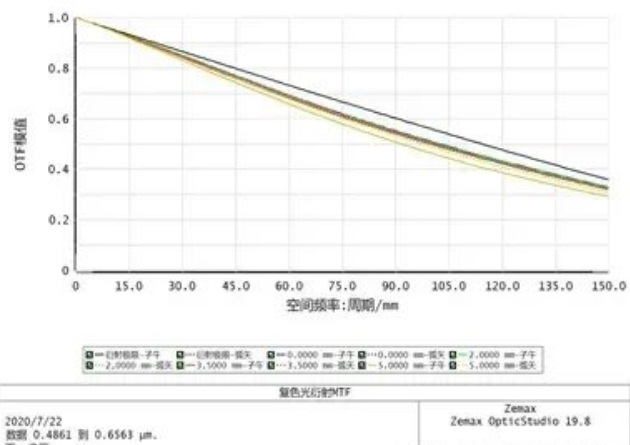
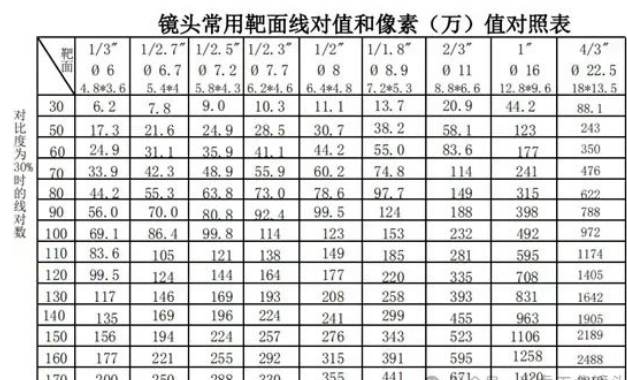
For machine vision systems, the maximum frequency corresponding to 30% contrast can be considered its resolution. When the resolution is sufficient, it is advisable to choose a lens with better contrast, as good image quality can significantly improve the efficiency and accuracy of the system.
As shown in the figure, when the contrast is 30%, the line pairs are 150 lp/mm, and according to the formula single pixel size = 1 / (line pairs * 2), the lens resolution at this point is 3.3 μm.
FALenses Technology specializes in providing machine vision core hardware. You can go to the official website of FALenses Technology at https://www.falenses.com/ for more information.