
Global Agents Wanted! Join us to share market opportunities. Comprehensive training, technical support, and attractive incentives provided. Act now for a brilliant future! Contact email: partners@falenses.com
Choosing the Right Industrial Camera
Industrial cameras come with various parameters, and selecting the appropriate one involves considering these parameters along with the precision requirements of the project. Here are the key steps and considerations when choosing the right industrial camera:
General Steps for Selecting an Industrial Camera
-
Determine System Accuracy and Camera Resolution
Start by understanding the required accuracy for your system and the resolution of the industrial camera needed to achieve that accuracy. -
Consider System Speed and Camera Imaging Speed
Identify the required speed of your system and ensure that the industrial camera can meet that requirement in terms of frame rate and data throughput. -
Account for Compatibility with Image Acquisition Hardware
Consider the industrial camera and image acquisition card together, as compatibility between the two is crucial. Ensure that the camera's interface and the frame grabber or other data acquisition system are compatible. -
Compare Prices
After assessing technical parameters, consider the cost of different camera options to find one that fits within your budget.
Calculating the Required Camera Resolution
To calculate the required camera resolution (in pixels), you can use the following formulas:
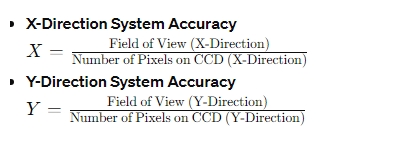
These formulas can help you determine the pixel count required based on the system's desired accuracy and field of view. Keep in mind that theoretical pixel counts should consider system precision and sub-pixel methods.
Determining the Required Camera Speed
To determine the required speed for the industrial camera, consider the following:
- System Operating Speed
The system's operating speed is the sum of the imaging speed (including data transfer) and the inspection speed. Although the imaging speed can be theoretically calculated based on asynchronous trigger functions, shutter speed, and other factors, it's best to test this in practice with software to ensure accuracy.
Choosing the right industrial camera involves a balance between these technical requirements and the cost. To achieve optimal results, consider testing with a sample camera to confirm that it meets the system's speed, accuracy, and compatibility needs.
FALenses Technology specializes in providing machine vision core hardware. You can go to the official website of FALenses Technology at https://www.falenses.com/ for more information.