
Global Agents Wanted! Join us to share market opportunities. Comprehensive training, technical support, and attractive incentives provided. Act now for a brilliant future! Contact email: partners@falenses.com
To choose a suitable line scan lens and camera, a set of formulas and steps can be used to calculate the required specifications for your application. Here's a summary of the calculations and the process for selecting a line scan lens and camera, along with an example based on the given input:
Step 1: Calculate the Required Resolution
Given:
- Width of the object/scan (W): 1600 mm
- Minimum detection precision (P): 1 mm
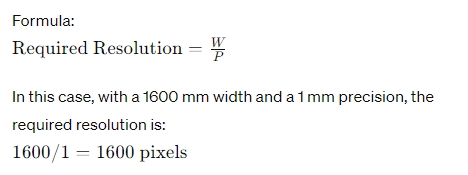
Step 2: Choose the Camera Resolution
Given the calculated resolution, choose a camera that meets or exceeds this requirement.
For the example provided, you mentioned a 2k (2048 pixels) camera, which exceeds the 1600 pixel requirement.
Step 3: Calculate the Actual Detection Precision
With a camera resolution of 2048 pixels, the actual detection precision can be calculated:
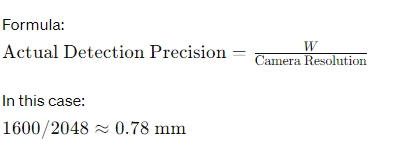
Step 4: Determine the Line Scanning Frequency
Next, calculate the required line scanning frequency based on the object movement speed and the actual detection precision.
Given:
- Movement speed: 22,000 mm/s
- Actual detection precision: 0.78 mm
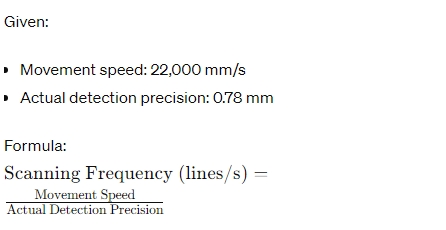
With a speed of 22,000 mm/s and a detection precision of 0.78 mm, the scanning frequency is: 22,000/0.78≈28,205 Hz22,000/0.78≈28,205 Hz
Thus, you would need a camera capable of scanning at around 28 kHz, which aligns with the mentioned requirement of a 28 kHz, 2048-pixel camera.
Step 5: Choose the Line Scan Lens
To select the lens, consider the sensor size and object distance:
Given:
- Sensor length: This can be calculated as (pixel width × pixel count).
- Working distance and object width: The ratio of the sensor length to the object width determines the required magnification.
Using the example:
- Sensor length: If the sensor has 2048 pixels, the total sensor length is 2048 × 1 = 2048 pixels.
- Magnification: The ratio of the sensor length to the object width.
With this information, you can determine the specifications for the lens and choose one that fits your requirements, focusing on magnification, working distance, and field of view.
By following these steps and formulas, you can select an appropriate line scan camera and lens for your application.
FALenses Technology specializes in providing machine vision core hardware. You can go to the official website of FALenses Technology at https://www.falenses.com/ for more information.