
Global Agents Wanted! Join us to share market opportunities. Comprehensive training, technical support, and attractive incentives provided. Act now for a brilliant future! Contact email: partners@falenses.com
Types of Lighting Techniques in Machine Vision
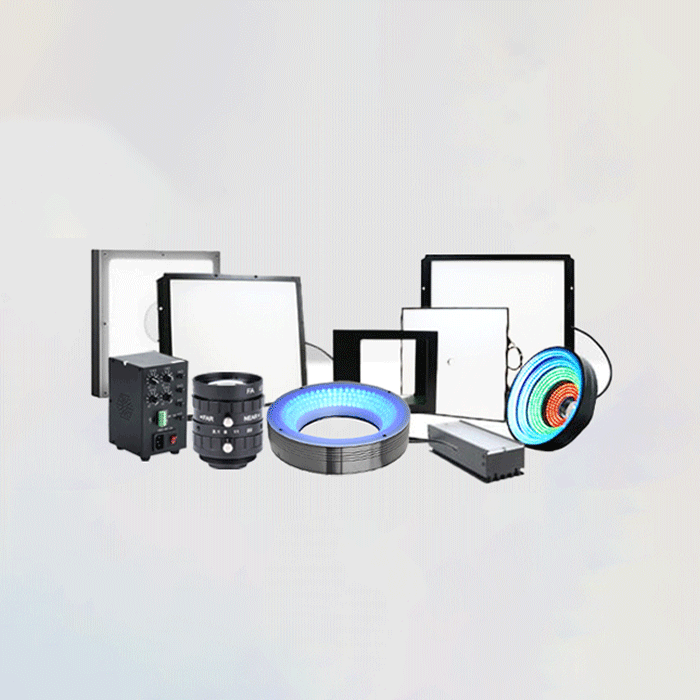
The ultimate goal of machine vision is to extract the necessary image features for subsequent actions in the visual system. Therefore, the quality of imaging affects the stability and success of the entire machine vision system. Higher image contrast allows for faster and more stable software algorithms. The quality of the imaging depends largely on the appropriate lighting method. Different samples and inspection tasks require different lighting techniques.
When selecting machine vision light sources, consider various parameters such as wavelength, uniformity, type of light source, size, color, angle, brightness, and how to control these aspects.
Below are various lighting techniques used in machine vision, along with their applications:
1. High-Angle Lighting
Light Path Description: Light at an angle greater than 45 degrees relative to the horizontal plane is considered high-angle light.
Effect Analysis: High-angle lighting creates reflections from the smooth parts of the target surface into the camera lens, resulting in higher grayscale values. Rough areas, where the light doesn't reflect into the lens, appear darker.
Main Applications: Positioning, character recognition, contour detection, scratch detection, and dimension measurement.
Common Light Sources: High-angle ring lights, bar lights, area lights, coaxial lights, point lights, etc.
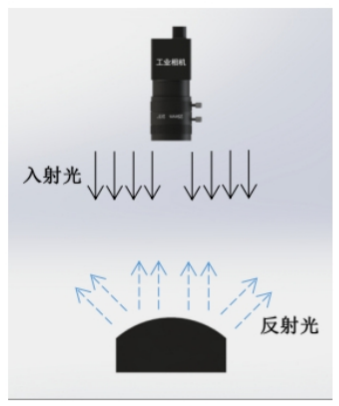
2. Low-Angle Lighting
Light Path Description: Light at an angle less than 45 degrees relative to the horizontal plane is considered low-angle light.
Effect Analysis: Low-angle lighting prevents reflections from flat surfaces from reaching the lens, leading to lower grayscale values. Uneven surfaces, however, create reflections that enter the lens, resulting in higher grayscale values.
Main Applications: Positioning, character recognition, contour detection, scratch detection, and dimension measurement.
Common Light Sources: Low-angle ring lights, bar lights, line lights, etc.
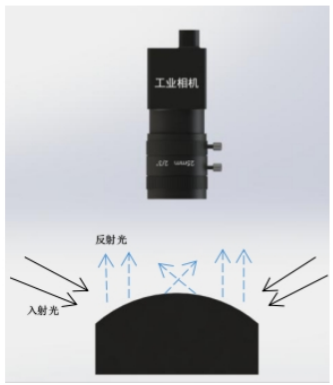
3. Shadowless Lighting
Light Path Description: By using a structure or diffusion plate, shadowless lighting includes both high-angle and low-angle light.
Effect Analysis: This lighting technique combines the effects of high-angle and low-angle light, providing multi-angle illumination. This reduces texture and wrinkle visibility, creating more uniform images.
Main Applications: Positioning, dimension measurement, curved product surface inspection.
Common Light Sources: Dome lights, shadowless ring lights, shadowless square lights, light boxes, etc.
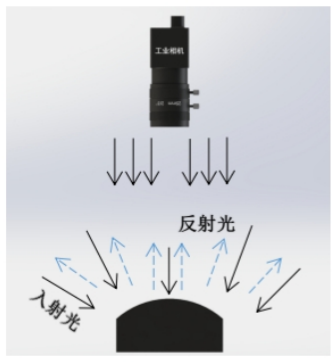
4. Coaxial Lighting
Light Path Description: In coaxial lighting, reflected light is parallel to the lens axis.
Effect Analysis: After reflecting from a flat surface, the light enters the lens parallel to the optical axis. In this case, the target surface acts like a mirror, and when the "mirror" has irregularities, they become significantly apparent.
Main Applications: Scratch detection, imprint detection, raised or recessed point detection, contour detection.
Common Light Sources: Coaxial lights, parallel coaxial lights, area lights, line lights.
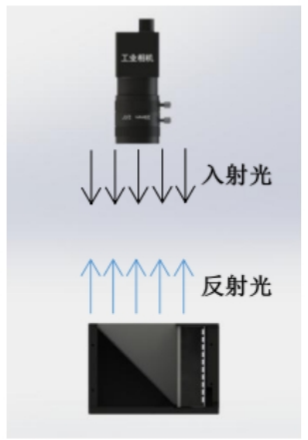
5. Backlighting
Light Path Description: The light source is positioned below the object being inspected, and in the absence of obstructions, light directly enters the lens, resulting in high grayscale values. Since the object blocks the light, its contour becomes visible in the image.
Main Applications: Extracting object contours.
Common Light Sources: Area lights, backlights.
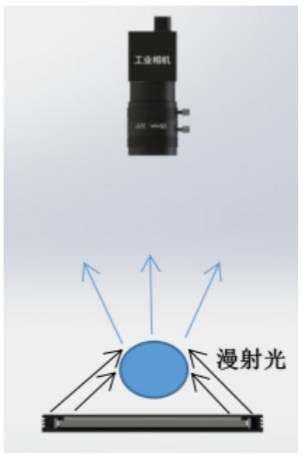
6. Diffuse Backlighting
Light Path Description: In diffuse backlighting, the light is scattered through a diffusion plate.
Effect Analysis: When extracting contours, images may appear blurred on the edges if the object has thickness or curvature. However, for flat objects, the image remains stable and cost-effective.
Main Applications: Positioning, dimension measurement, presence detection, defect detection.
Common Light Sources: Area lights.
7. Parallel Backlighting
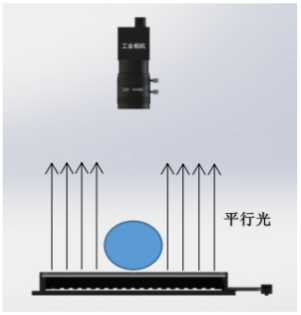
Light Path Description: Parallel backlighting uses parallel structures to emit parallel light.
Effect Analysis: Parallel light can accurately capture the outer contours of irregularly shaped objects, providing clear and sharp edges for cylindrical products or objects with chamfers or rounded corners. This technique is typically used with telecentric lenses for high precision.
Main Applications: Dimension measurement.
Common Light Sources: Parallel area lights, parallel coaxial lights.
FALenses Technology specializes in providing machine vision core hardware. You can go to the official website of FALenses Technology at https://www.falenses.com/ for more information.