
Global Agents Wanted! Join us to share market opportunities. Comprehensive training, technical support, and attractive incentives provided. Act now for a brilliant future! Contact email: partners@falenses.com
Machine vision is a comprehensive technology that includes image processing, mechanical engineering, control, electrical lighting, optical imaging, sensors, analog and digital video technology, computer software and hardware technology (image enhancement and analysis algorithms, image cards, IO cards, etc.). A typical machine vision application system includes image capture, light source system, image digitization module, digital image processing module, intelligent judgment and decision-making module, and mechanical control execution module.
A typical industrial machine vision system includes: visual light source, lens (fixed focus lens), zoom lens, telecentric lens, microscope lens), camera (including CCD camera and COMS camera), image processing unit (or image capture card), image processing software, monitor, communication I/O unit, etc.
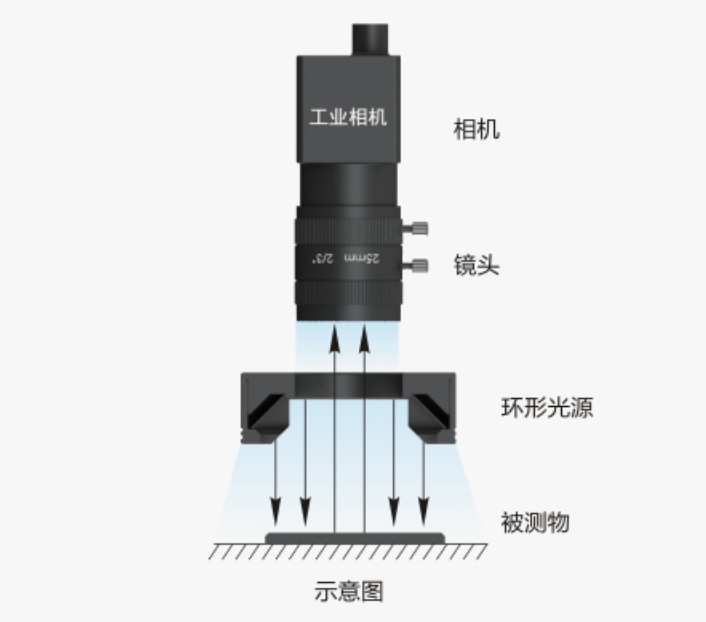
1、 Why use light sources? What is the role of visual light sources in machine vision detection?
Purpose: To separate the measured object from the background and obtain high-quality, high contrast images. A good light source can greatly reduce irrelevant background information and highlight the characteristics of the measured object. Importance: It directly affects processing accuracy and speed, and even the success or failure of machine vision systems. Excellent lighting engineering can reduce the difficulty of algorithm development.
2、 Machine vision requirements for light sources
(1) Contrast: The fundamental purpose of lighting the detected object is to improve the contrast between the defect and the background, highlight the defect, and facilitate further processing by machine vision algorithms. It is one of the most important references for light source selection.
(2) Uniformity; Uneven lighting can bring many inconveniences to later image processing, and even make the collected images useless for processing. For example, smooth parts will produce specular reflections, resulting in dazzling light spots on their surface. If defects are just covered by the light spots, there may be missed or false detections.
(3) Brightness: If the brightness is too high, defects may be submerged. If the brightness is too low, the contrast of defects may not be obvious, and lighting will lose its original meaning. Therefore, it is necessary to choose the brightness of the light source reasonably.
(4) Stability: refers to the stable emission of light from a light source within a time range.
(5) Cost and lifespan: High priced items may not necessarily be the most suitable or affordable. The longer the service life of the light source, the better. Firstly, it can reduce expenses, and secondly, it can reduce the system adjustments caused by replacing the light source.
FALenses Technology specializes in providing machine vision core hardware. You can go to the official website of FALenses Technology at https://www.falenses.com/for more information.