
Global Agents Wanted! Join us to share market opportunities. Comprehensive training, technical support, and attractive incentives provided. Act now for a brilliant future! Contact email: partners@falenses.com
Ⅰ.What is a lens?
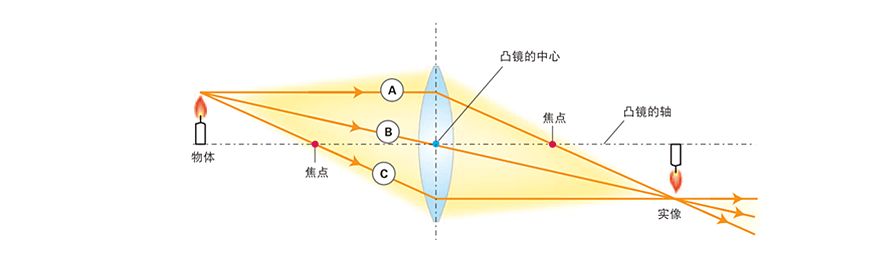
Simply put, a lens is a device that collects light from an object at one end and converges the light to form a real image at the other end, projecting it onto the receiving surface. The point where the light rays converge is called the focal point, and the distance from the center of the lens to the focal point is known as the focal length.
When the lens is a convex lens, the focal length varies depending on the degree of thickness, or "expansion," of the lens. The greater the degree of expansion, the shorter the focal length will be.
Ⅱ. Important Parameters of Lenses
Friends who are into photography are aware that the basic parameters of a lens include focal length (telephoto, wide-angle, zoom range), F-number (indicating light transmittance), and so on.
In comparison, industrial lenses focus more on the following parameters:
-
WD (Work Distance) WD refers to the distance from the top of the lens to the subject when the focus is aligned with the subject. It is also known as the working distance. When using a CCD, the proportional formula for work distance: field of view = focal length : CCD size holds true.
-
Focal Length (Focus Distance) In FA (Factory Automation) lenses, representative lenses have focal lengths such as 8 mm / 16 mm / 25 mm / 50 mm, etc. Based on the required field of view and focal length of the subject you want to capture, you can calculate the focal position = WD (work distance)
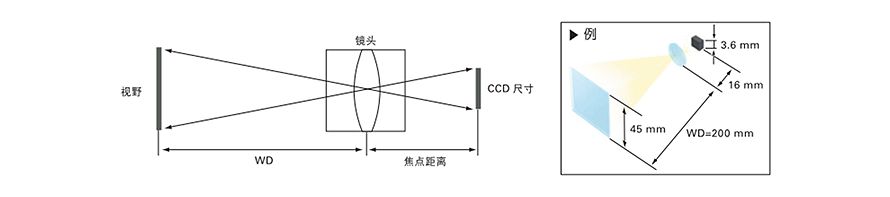
Work distance (WD) and field of view are determined by the lens's focal length and the size of the CCD. For example, with a lens having a focal length of 16 mm and a CCD size of 3.6 mm, if you want to set the field of view to 45 mm, the WD becomes 200 mm.
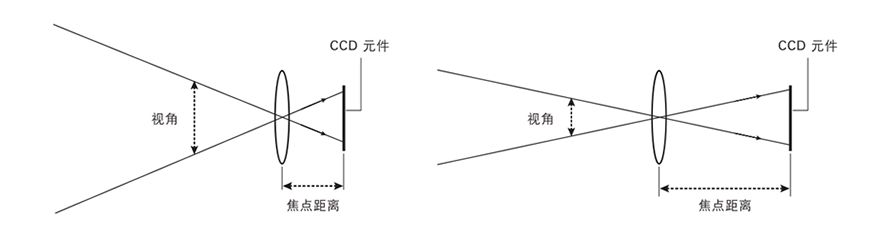
3.Field of View The field of view refers to the range of capture within the working distance. Generally speaking, the longer the working distance between the subject and the lens, the wider the field of view (field of view angle). Additionally, the width of the field of view is determined by the lens's focal length. The angle of the range that can be captured using the lens is referred to as the angle of view or field of view angle. The shorter the focal length of the lens, the larger the angle of view, and the wider the field of view. Conversely, the longer the focal length, the more it can magnify distant subjects.
- Depth of Field Depth of field refers to the range of distances (along the axis of the camera's lens) within which objects appear acceptably sharp. When this range is large, it is referred to as "deep depth of field," and when it is small, it is called "shallow depth of field." Technically speaking, there is only one true focus point, but the human eye perceives the image as being in focus within a certain range, and this range is what we term as the depth of field.
As shown in the figure below, when we compare the situation of having a larger aperture (wide open) and a smaller aperture (narrowed down) while photographing an object with tape indicating height on a sloped surface.
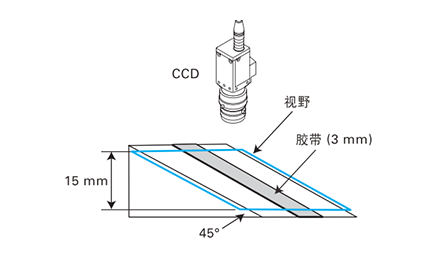
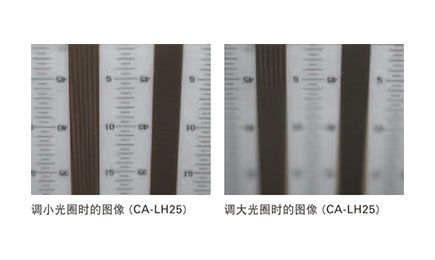
The actual depth of field must be determined through practical measurement. This is because, in addition to the structure of the lens itself, there are many factors that affect the depth of field:
-
The lens itself.
-
The smaller the aperture, the greater the depth of field.
-
The brighter the illumination, the greater the depth of field (slower shutter speed, greater depth of field).
-
The smaller the focal length, the greater the depth of field.
-
The greater the working distance (WD), the greater the depth of field.
-
The larger the diameter of the individual pixels on the CCD, the greater the depth of field.
-
Lens Resolution The resolution of a lens is not only used in image processing; it refers to the smallest separable interval that a lens used in all optical measuring instruments can observe. For example, a lens with a resolution of 10 μm can clearly observe parallel stripe lines with a line width and spacing of 10 μm. When the resolution is insufficient, people feel that two lines seem to overlap. In this case, a lens with higher resolution is required.
-
Lens Magnification The so-called magnification refers to the ratio of the actual size of the object being inspected to its image size through an optical measuring instrument. In the past, when observing through the eyepiece of a microscope, we used the concept of optical magnification. However, in recent years, with the increasing number of systems that can display the object on a liquid crystal display, the concept of display magnification has also become popular. Optical Magnification When considering the principle of a digital camera, optical magnification can be obtained by "CCD effective pixel size ÷ field of view." Display Magnification Display magnification can be obtained by "display diagonal ÷ CCD pixel diagonal × optical magnification."
- F-Number
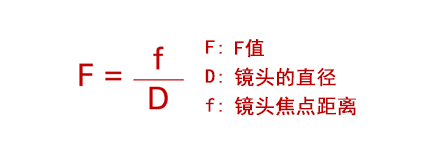
The F-number, or F-value, is a standard that indicates the brightness of a lens. More precisely, it is the value obtained by dividing the lens's focal length by the lens diameter (aperture). The "F" in F-number comes from the word "focal" (relating to the focus).
In reality, lenses do not allow all light to pass through; some portion of it is reflected. Moreover, to reduce aberrations when using multiple lenses, the amount of light that passes through decreases.
Therefore, lenses that allow more light to pass through and can produce a bright image are referred to as "bright," while lenses that allow less light are referred to as "dark." The relationship between the lens's focal length and diameter is one of the significant factors that can greatly influence the brightness or darkness of a lens, that is, the F-number. Lenses with a smaller F-number are called "bright lenses," and those with a larger F-number are called "dark lenses." Typically, small cameras will have markings such as "F=2.5" or "1:2.5" next to the lens, indicating an F-number of 2.5.
In terms of camera lens performance, if the F-number reaches around 2.0, it indicates that the camera has a very high level of brightness.
- Distortion (Aberration)
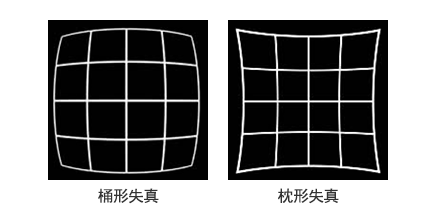
Distortion (aberrations) refers to the state where the image formed through the lens is distorted. In fact, there is no lens with a perfect shape. Therefore, although theoretically parallel light rays should propagate in a straight line after passing through the lens, in reality, the light will bend outward or inward after passing through the lens. The former is called "barrel distortion," and the latter is called "pincushion distortion." The degree of distortion in a lens is represented as a percentage.
3. Telecentric lens
Everyone has this impression. To the human eye, an object appears to be larger or smaller near or far. This is because when the object is close, the projection on the retina is large, and when it is small, the projection is small. The same is true for the lens. Errors will occur due to the large and small distance. This is especially critical when doing size measurements.
In order to solve this problem, telecentric lenses were produced. Simply put, it is a lens that will not change the size of the projection end due to the distance of the WD working distance.
For products with thickness measurement, the cross-section effect will also be shown.
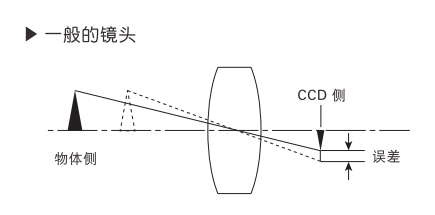
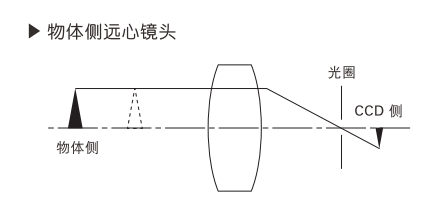
Telecentric lenses are mainly used for precision measurement. In precision optical measurement systems, ordinary optical lenses will have certain constraints, such as image deformation, errors caused by perspective selection, boundary uncertainty caused by interference from inappropriate light sources, etc., which in turn affect the accuracy of measurement. Telecentric lenses can effectively reduce or even eliminate the above problems. Therefore, Telecentric lenses have become a decisive component of precision optical measurement systems, and their application fields are becoming more and more extensive.
A simple comparison between telecentric lenses and ordinary lenses is as follows:
Advantages of ordinary lenses
Low cost, practical and versatile.
Disadvantages of ordinary lenses
Magnification will vary and there will be parallax.
General lens application
Imaging large objects.
Advantages of telecentric lenses
The magnification is constant, does not change with the depth of field, and has no parallax.
Disadvantages of telecentric lenses
High cost, large size and heavy weight.
Applications of telecentric lenses
Metrology, CCD-based measurement, microcrystallinology
FALenses Technology specializes in providing machine vision core hardware. You can go to the official website of FALenses Technology at https://www.falenses.com/ for more information.