
How Does Machine Vision Lighting Work?
Machine vision systems rely heavily on proper lighting to achieve precise positioning, accurate measurements, inspection, and recognition. The lighting in machine vision affects system stability, and even small variations in illumination can lead to significant issues, such as image edge shifts or detection errors. Let's explore the different lighting methods used in machine vision and understand their applications.
Common Lighting Methods in Machine Vision:
1. Direct Illumination
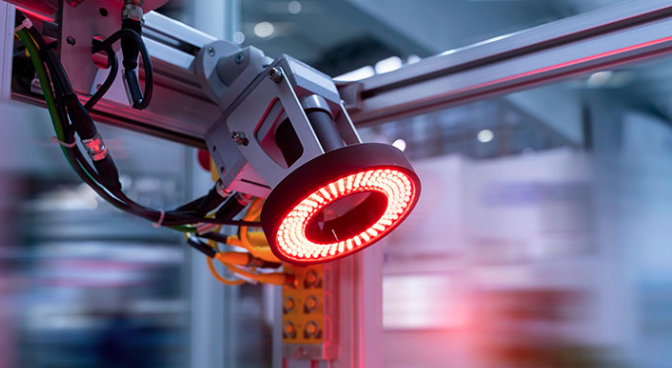
Direct illumination involves shining light directly onto the object to obtain clear images with high contrast. This method is effective when high contrast is needed. However, direct illumination on reflective surfaces can cause glare or specular reflections. Ring lights or point lights are commonly used for direct illumination, with ring lights often mounted around the camera lens to provide consistent illumination.
2. Dark Field Illumination
Dark field illumination provides low-angle lighting relative to the object's surface. If the camera captures a reflection of the light source in its field of view, it's considered bright field illumination. If the light source is not visible, it's dark field illumination. This method is useful for highlighting surface irregularities or textures and is often used to detect raised or textured features on a surface.
3. Backlight Illumination
Backlight illumination involves shining light from behind the object, creating a silhouette that emphasizes the object's edges. This method is commonly used for precise measurements of object dimensions and orientation. Backlight illumination provides high contrast, but surface details are lost. It is effective for measuring the diameter of a coin but cannot differentiate its front and back.
4. Coaxial Illumination
Coaxial illumination uses a beam splitter or half-mirror to direct light downward along the same axis as the camera lens. The camera views the object through the beam splitter. This method is particularly useful for inspecting highly reflective objects and is suitable for situations where shadows are problematic. Coaxial illumination is often used for inspecting shiny or reflective surfaces.
5. Diffuse Illumination
Diffuse illumination provides uniform lighting using a diffuser to scatter light evenly. This method reduces shadows and specular reflections, making it ideal for complex surfaces or surfaces with multiple angles. Diffuse illumination is often used in applications like inspecting fully assembled circuit boards, where even lighting is required over a large area.
Conclusion:
Machine vision lighting plays a crucial role in achieving high-quality imaging and reliable detection. Different lighting methods offer unique benefits depending on the application and object characteristics. Direct illumination is useful for high-contrast imaging, dark field illumination highlights surface irregularities, backlight illumination emphasizes object edges, coaxial illumination is ideal for reflective surfaces, and diffuse illumination reduces shadows and reflections.
If you need guidance in selecting the right lighting method for your machine vision application, companies like FALenses Technology offer expert advice and a wide range of lighting solutions. Properly designed lighting can significantly enhance the performance and accuracy of your machine vision system.
FALenses Technology specializes in providing machine vision core hardware. You can go to the official website of FALenses Technology at https://www.falenses.com/ for more information.