
Introduction to Coaxial Lens
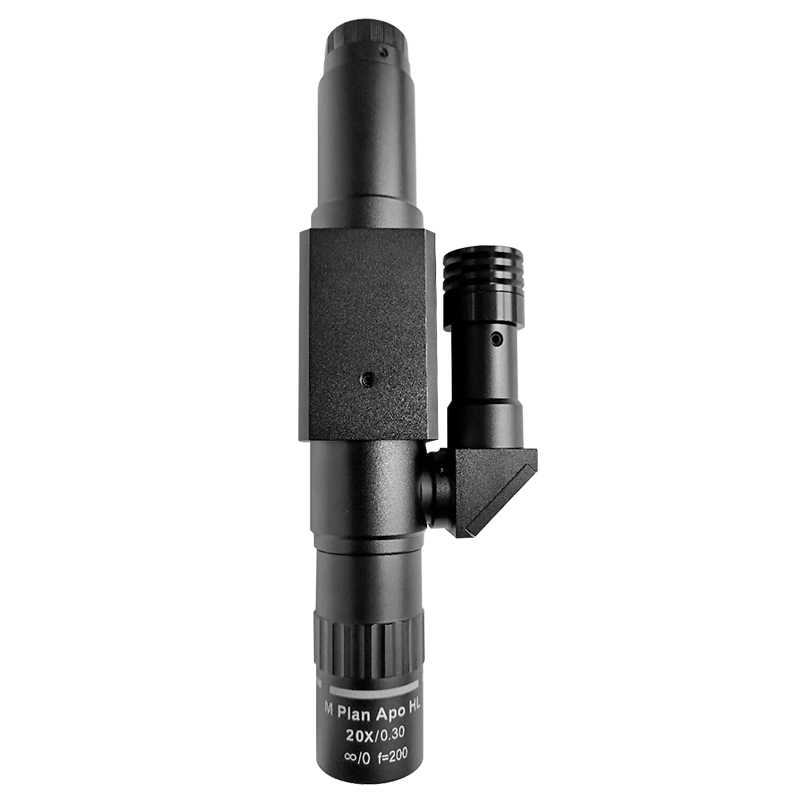
I. What is a Coaxial Lens?
A coaxial lens, also known as a coaxial lighting lens, utilizes coaxial incident light illumination technology. The coaxial light source (diffused coaxial light, metal plane diffuse reflective illumination source) provides more uniform lighting than traditional light sources, improving the accuracy and reproducibility of machine vision. It uniformly illuminates flat, glossy surfaces and enhances engraved, recessed, or imprinted features.
II. Features
- Standard CCD Interface
- Compatible with CCD (Charge-Coupled Device) cameras, ensuring broad applicability in machine vision systems.
- Integrated LED Coaxial Illumination
- Built-in LED lighting for consistent and reliable illumination.
- Magnification Ranges from 1X to 16X
- Offers versatility in magnification to suit different inspection requirements.
- Wide Application in Machine Vision
- Suitable for various machine vision systems, providing reliable performance and high-resolution imaging.
III. Industry Applications
Coaxial lenses are widely used in several industries, including electronics, geology, educational experiments, and other fields. They are particularly suitable for examining microscopic objects with reflective characteristics that require coaxial illumination for accurate observation.
IV. Working Principles
- Differentiating Coaxial and Non-Coaxial Lenses
- Telecentric optical lenses can be divided into coaxial and non-coaxial lenses. Coaxial telecentric lenses often have a beamsplitter to offer more uniform illumination, with low distortion, large depth of field, and high telecentricity.
- Coaxial Light's Role in Telecentric Lenses
- The unique optical design of coaxial telecentric lenses can filter light that is coaxial with the camera. By utilizing light and dark contrasts, they can highlight the distinctive features of the measured object, helping machine vision systems capture product defects with greater ease and efficiency.
- Application in PCB Board Guidance and Positioning
- Coaxial telecentric lenses are used in PCB guidance and positioning systems, allowing product images to remain clear within a certain height range, ensuring system stability and reliability.
Conclusion
Coaxial lenses play a vital role in modern industrial applications, especially in machine vision and electronics manufacturing. Their unique design and capabilities offer precise inspection and reliable performance, making them indispensable in many industrial processes.
FALenses Technology specializes in providing machine vision core hardware. You can go to the official website of FALenses Technology at https://www.falenses.com/ for more information.