
Microscope Objective Lenses
Microscopes are commonly used optical instruments that can magnify and display extremely small objects, widely used in biology, medicine, materials science, and other fields. Among them, objective lenses and eyepieces are core optical components, and both typically have very short focal lengths, often only a few millimeters. Below, we discuss in detail why objective lenses and eyepieces have such short focal lengths, from both optical principles and structural design perspectives.
Optical Principles
-
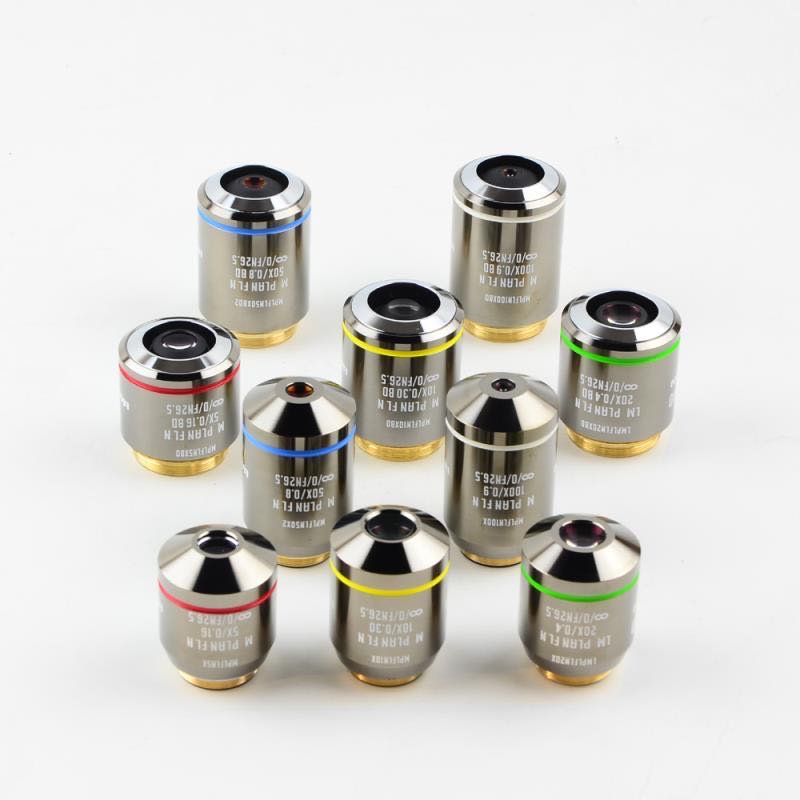
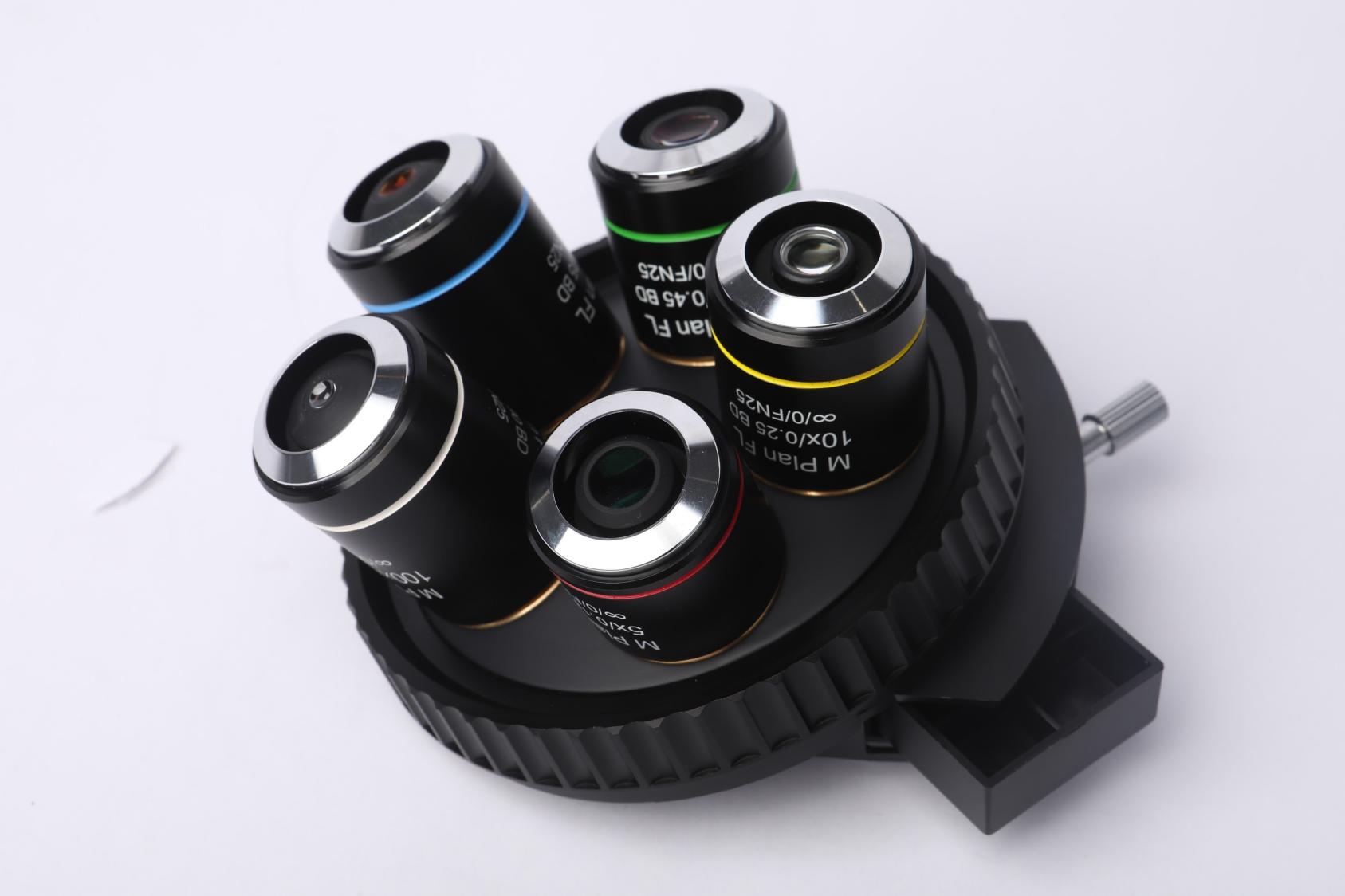
Objective Lens with a Very Short Focal Length The main function of the objective lens in a microscope is to magnify minute details in a sample onto the microscope's imaging plane, which requires a high magnification factor. Generally, the higher the magnification, the shorter the working distance and, consequently, the shorter the focal length. This is because in optical systems, magnification equals the ratio of focal lengths, so a shorter focal length corresponds to higher magnification. However, with increased magnification, the depth of field also decreases, necessitating shorter focal lengths for higher magnification.
-
Eyepiece with a Very Short Focal Length The primary role of the eyepiece is to further magnify the real inverted image produced by the objective lens so it can be observed by the human eye. Since the human visual system and optical systems have different image resolution capabilities, the eyepiece must further magnify the image to enhance clarity and contrast. However, given that the real image produced by the objective is already small, the eyepiece needs to have a higher magnification, which requires a shorter focal length to achieve the desired magnification.
Structural Design
-
Short Distance Between Objective and Eyepiece In microscope design, the distance between the objective and the eyepiece can also impact imaging quality. If this distance is too large, it can lead to image distortion, blurring, or color shifting. Thus, the distance between the objective and the eyepiece is typically designed to be very short, which inherently requires shorter focal lengths for both components.
-
Imaging Plane Positioned Near the Objective The imaging plane of a microscope is the final position where the image is formed. For the same size imaging plane, the required focal length of optical components decreases as the imaging plane moves closer to the objective. To reduce the optical system's size, the imaging plane is usually placed near the end of the objective, further shortening the distance between the objective and the eyepiece.
Summary
In summary, the reason microscope objective lenses and eyepieces have very short focal lengths is a combination of optical principles and structural design. In terms of optical principles, shorter focal lengths enable higher magnification for the objective lens and higher magnification for the eyepiece to further magnify the real image. Structurally, the short distance between the objective and the eyepiece necessitates shorter focal lengths, and positioning the imaging plane at the end of the objective allows for a more compact design.
The very short focal lengths of microscope objective lenses and eyepieces are a key characteristic in microscope design, offering high magnification and clarity. However, in actual applications, microscope imaging systems are influenced by numerous factors, such as sample thickness, working distance of the objective and eyepiece, and the position of the imaging plane. These factors can make microscope imaging systems quite complex. Therefore, designing an excellent microscope requires considering all these factors to achieve optimal imaging results.
FALenses Technology specializes in providing machine vision core hardware. You can go to the official website of FALenses Technology at https://www.falenses.com/ for more information.