
Infinity-corrected objective lenses are used in various imaging and laser focusing applications. These lenses collimate light after it exits the objective, meaning that the light is parallel when it leaves the lens. In imaging applications, an additional lens, typically called a "tube lens," is needed to focus the light collected from the sample onto a sensor. Infinity-corrected objectives are designed to be used with a specific focal length tube lens to achieve the nominal magnification.
One of the advantages of infinity-corrected objectives over finite conjugate objectives is that various auxiliary optical components, such as optical filters and polarizers, can be inserted between the objective and the tube lens without changing the way light propagates along the optical path and forms an image. In applications like optical tweezers and laser cutting, infinity-corrected objectives allow the laser beam entering the objective's back aperture to be tightly focused to the diffraction limit, providing high light power and excellent resolution.
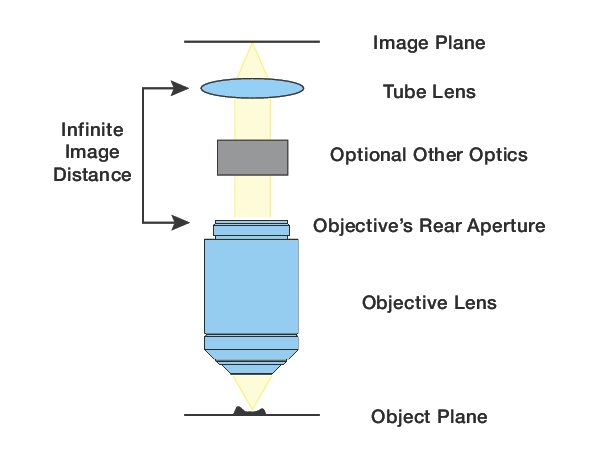
Key Characteristics of Infinity-Corrected Objectives
-
Optical Design: Infinity-corrected objectives use a collimated light path, which allows for additional optical elements to be inserted without affecting the final image. This flexibility makes them suitable for complex imaging and laser applications.
-
Application in Microscopy: Infinity-corrected objectives are widely used in microscopy. These objectives offer the ability to insert optical elements such as polarizers, beam splitters, or fluorescence cubes without affecting the imaging system's focus or alignment. This flexibility allows for advanced imaging techniques and configurations.
-
Magnification and Numerical Aperture (NA): The overall magnification of a microscope system is the product of the magnification of the objective and the magnification of the eyepiece. Infinity-corrected objectives are available in various magnifications, typically represented as a number with "x" (e.g., 10x, 20x, 50x).
The numerical aperture (NA) is the most crucial optical parameter for objective lenses. It is a dimensionless quantity representing the range of angles over which the objective can accept light. The higher the NA, the more light the objective can collect, leading to higher resolution and better imaging quality. NA is defined as: NA=�×sin(�) where � is the refractive index of the medium between the lens and the object, and � is the half-angle of the cone of light that can enter the lens.
Conclusion
Infinity-corrected objective lenses play a vital role in high-quality imaging systems and laser applications. Their flexibility, due to the collimated light path, allows for advanced imaging techniques and configurations, making them indispensable in microscopy and other precision applications. Understanding their characteristics, magnification, and numerical aperture is essential for obtaining optimal imaging results and achieving high-resolution microscopy.
FALenses Technology specializes in providing machine vision core hardware. You can go to the official website of FALenses Technology at https://www.falenses.com/ for more information.