
In a machine vision system, the lens is equivalent to the human eye, and its main function is to focus the optical image of the target on the photosensitive array of the image sensor (camera). All image information processed by the visual system is obtained through the lens, and the quality of the lens directly affects the overall performance of the visual system. The following is a detailed explanation of the relevant professional terms of machine vision industrial lenses.
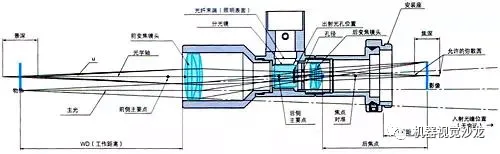
1. Telecentric optical system:
Refers to an optical system in which the chief ray is parallel to the optical axis of the lens. The light emitted from the object toward the lens remains parallel to the optical axis, even outside the axis, and is called an object-side telecentric optical system. If the light from the lens to the image remains parallel to the optical axis, or even outside the axis, it is called an image-side telecentric optical system.
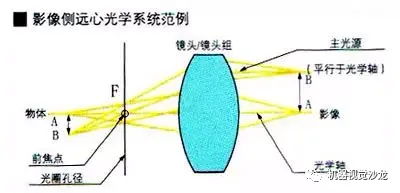
2. Telecentric lens:
A telecentric lens refers to a lens whose chief ray is parallel to the lens light source. There are telecentric methods on the object side, telecentric on the imaging side, and telecentric on both sides.
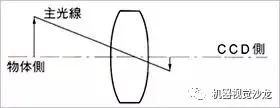
The chief ray is at an angle to the optical axis of the lens, so the size of the image changes as the workpiece moves up and down.
Two distant states of mind
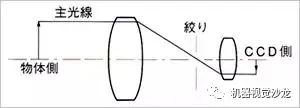
The main ray is parallel to the optical axis in both the main object side and the image side. The aperture
is variable. It can obtain a high depth of field and obtain a more stable image than the object side
telecentric lens. It is most suitable for image processing optical systems for measurement, but it requires large-scale costs. high
Things are far away
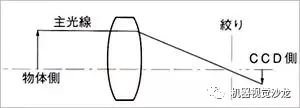
Only the principal ray of the object plane is parallel to the main axis of the lens and
the workpiece changes up and down, and the size of the image basically does not change. This is
a necessary condition when using coaxial epi-illumination, and it can also be reduced in size.
Like Fang Yuan's state of mind
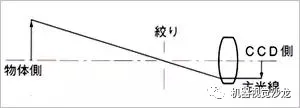
The main ray of the image
side is parallel to the optical axis of the lens. Even if there is individual difference in the camera installation, it can absorb the change of the photographic magnification
for color shift compensation. Cameras should use this lens.
3. Features of telecentric optical system:
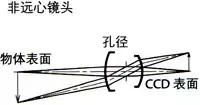
advantage:Smaller size. Reducing the number of lenses can reduce costs.
shortcoming:When you move the surface of an object up or down, you change the size or position of the object.
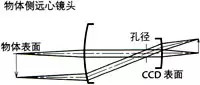
advantage:Smaller size. Reducing the number of lenses can reduce costs.
shortcoming:When you move the surface of an object up or down, you change the size or position of the object.
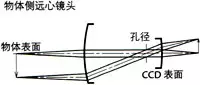
Advantages: Does not change object size or position when moving the surface up and down. Can use smaller dimensions when using coaxial illumination.
Disadvantages: Larger than standard lens size when not using coaxial illumination.
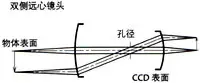
Advantages: Similar to MML, but improves accuracy when the size of the rear end of the lens flange is very different.
Disadvantages: Similar to MML, but more expensive than MML.
4. Telecentricity:
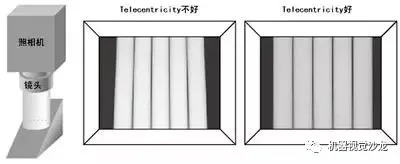
Telecentricity refers to the magnification error of an object. The smaller the magnification error, the higher the Telecentricity. Telecentricity has various uses, and it is important to understand the Telecentricity before using the lens. The main ray of a telecentric lens is parallel to the optical axis of the lens. If the Telecentricity is not good, the effect of the telecentric lens will not be good. Telecentricity can be simply confirmed using the following figure.
5. Resolution (μm):
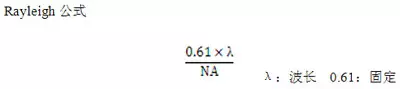
A measure of the ability of an optical system to indicate the maximum number of pairs of black and white stripes that can be observed in 1 mm when a black and white grid pattern is observed through a lens. The resolution is the measured value of the closest distance that two points can get closer before they cannot be identified. For example, a resolution of 1 μm means that the closest distance that two points can get closer before they cannot be identified is 1 μm. The following is the formula for calculating the theoretical resolution based on the phase-free light diffraction of the lens.
6. Resolution (Lines/mm):
Resolution refers to the number of black and white stripes that can be identified within a 1mm area of the image in the black and white screen lens. The unit of resolution is lines/mm, for example, 100 lines/mm means that the black and white spacing can be identified as 1/100mm (10μm). The width of the black and white lines is 1/200mm (5μm).
7. Horizontal TV resolution (TV lines):
The total number of black and white horizontal lines in the width is equivalent to the vertical height of the TV screen. The ratio of the vertical to horizontal length of the screen is usually 3:4, so the total number of bars in the horizontal width is 3/4. The horizontal resolution of the TV is 240 TV lines, and the total number of horizontal lines of the TV screen is 320 lines. When measuring the resolution of a lens, a set of black and white lines should be considered one line, but in terms of TV resolution lines, a set is considered 2TV lines.
8. Distortion (%):
Distortion is the lens aberration when straight objects outside the optical axis appear curved. Lens distortion is also called lens distortion, which is a general term for the inherent perspective distortion of optical lenses. It can be divided into pincushion distortion and barrel distortion. The distortion of straight lines toward the center is called Pincushion Distortion, and the distortion that expands outward is called Pincushion Distortion. Is barrel distortion (Barrel Distortion). As shown below:
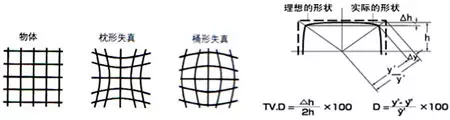
9. TV distortion (%):
The image on the TV screen is distorted. The closer the value is to zero, the higher the energy.

10. TV distortion:
The value calculated as the percentage of the distorted shape of the actual side length to the ideal shape.
11. Aperture efficiency marginal light amount (%):
Aperture efficiency is the brightness difference between the optical axis of the imaging disk and the surrounding area when using a lens to shoot an object of uniform brightness. The unit is percentage (%), assuming that the central brightness is 100. It is one of the optical characteristics of the lens.
12. Masking (%):
Occlusion is the difference in brightness between the center and the edge of a TV screen when using a lens and a CCD-TV lens to shoot an object of uniform brightness. The unit is a percentage (%). This percentage is usually calculated using the power ratio of the light receiving component to the CCD component. Occlusion refers to the overall performance of the lens and TV lens. Telecentric optical systems can be used to reduce occlusion.
13. Color difference:
In the lens optical system, the position where the image is formed and the image magnification vary with the wavelength of the light. Different wavelengths of light have different colors, which is called color distortion. Distortion along the optical axis is called color distortion. The difference in magnification is called magnification color distortion.
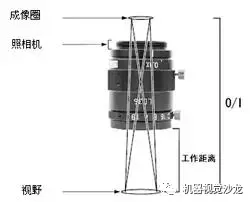
14. Working distance (WD) (mm):
Working distance refers to the distance from the first working surface of the lens to the object being measured.
15. Distance between objects and images O/I (Object to Imager)
OI refers to the distance from the object to the image plane.
16. Focal length f (mm) back focal length/front focal length
The focal length is the distance from the main light point of the optical system to the focal point. The distance from the vertex of the last lens to the back focus is the back focal length. The distance from the vertex of the first lens to the front focus is the front focal length.
17. Depth of Field:
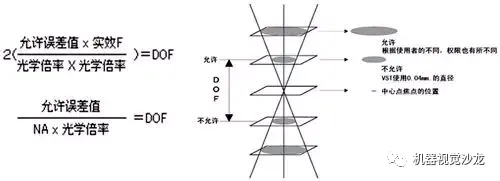
Depth is the distance between the closest point and the farthest point where the object is in sharpest focus when moving forward and backward from the best focus. The depth range on the object side is called the depth of field. Similarly, the range on the camera side is called the depth of focus. The specific depth of field value is slightly different. Depth of Field can be calculated using the following formula:
Depth of field = 2 x Permissible COC x Effective F / Optical magnification 2 = Permissible error value / (NA x Optical magnification) (using a 0.04mm Permissible COC)
The image through the lens will theoretically form a dot shape. The acceptable blur on the clear image is called the acceptable circle of confusion.
18. Depth of Focus:
Depth is the distance between the closest point and the farthest point where the sharpest focus appears when the CCD moves back and forth from the best focus. The depth range on the image side is called focal depth.
19. Back intercept (mm):
The distance from the front of the lens mounting plate to the image.
20. Specifications of C mounting base:
| name | Standard outer diameter | Number of screw threads (for 25.4 mm) | back intercept |
| U1 | 25.4000mm | 32Threads | 17.526mm |
21. Numerical aperture NA, NA':
When the half-angle produced by the object on the incident aperture is u, and the refractive index is n, nx sinu is the numerical aperture (NA) on the object side.
When the half-angle produced by the object on the exit aperture is u', and the refractive index is n', n' x sinu' is the image side numerical aperture {NA').
NA=nx sinu NA'=n' x sin u'
The higher the NA, the better the resolution and brightness of the lens. As shown in the figure below, the incident angle u, the refractive index n on the object side, and the refractive index 'n' on the imaging side: NA = NA' x magnification
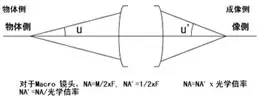
For Macro lens, NA = M/2 x F NA' = 1/2 x F NA = NA' x optical magnification NA' = NA x optical magnification
22. F value F No:
This value refers to the brightness of the lens. This value can be obtained by dividing the lens focus distance by the effective diameter of the object side (incident light hole diameter Dmm), or it can be calculated using NA and the optical magnification of the lens (β). The smaller the value, the brighter the lens.
F No = focal length / incident aperture or effective diameter = f / D
23. Effective F No:
This value is the brightness of the lens within a limited distance, and refers to the brightness during actual operation. The higher the optical magnification (β), the darker the lens.
Actual effect F = (1 + optical magnification) x F#, actual effect F = optical magnification / 2NA
24. Optical magnification β:
| The ratio of object size to image size. | ||
|
β |
=y'/y | |
| =b/a | ||
| =NA/NA' | ||
| =CCD lens element size/actual field of view size | ||
20. Specifications of C mounting base:
| name | Standard outer diameter | Number of screw threads (for 25.4 mm) | back intercept |
| U1 | 25.4000mm | 32Threads | 17.526mm |
21. Numerical aperture NA, NA':
When the half-angle produced by the object on the incident aperture is u, and the refractive index is n, nx sinu is the numerical aperture (NA) on the object side.
When the half-angle produced by the object on the exit aperture is u', and the refractive index is n', n' x sinu' is the image side numerical aperture {NA').
NA=nx sinu NA'=n' x sin u'
The higher the NA, the better the resolution and brightness of the lens. As shown in the figure below, the incident angle u, the refractive index n on the object side, and the refractive index 'n' on the imaging side: NA = NA' x magnification
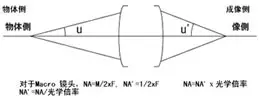
For Macro lens, NA = M/2 x F NA' = 1/2 x F NA = NA' x optical magnification NA' = NA x optical magnification
22. F value F No:
This value refers to the brightness of the lens. This value can be obtained by dividing the lens focus distance by the effective diameter of the object side (incident light hole diameter Dmm), or it can be calculated using NA and the optical magnification of the lens (β). The smaller the value, the brighter the lens.
F No = focal length / incident aperture or effective diameter = f / D
23. Effective F No:
This value is the brightness of the lens within a limited distance, and refers to the brightness during actual operation. The higher the optical magnification (β), the darker the lens.
Actual effect F = (1 + optical magnification) x F#, actual effect F = optical magnification / 2NA
24. Optical magnification β:
| The ratio of object size to image size. | ||
|
β |
=y'/y | |
| =b/a | ||
| =NA/NA' | ||
| =CCD lens element size/actual field of view size | ||
25. Optical magnification:
Magnification refers to the ability to change the size of the original imaging area of the subject through lens adjustment. Optical magnification is the magnification of the optical lens. The relationship between the main points and imaging: Magnification refers to the ratio of the image size to the object.
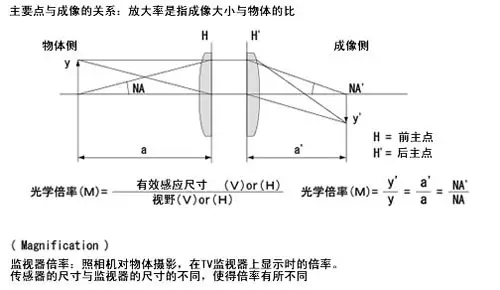
26. Electronic magnification:
Electronic magnification is the magnification of the image when it is displayed on the monitor screen compared to when it is displayed on the CCD.
27. Monitor magnification:
The display magnification is the magnification of the object displayed on the display through the lens.
Display magnification = (optical magnification β) x (electronic magnification)
(Calculation example) Optical magnification = 02x, CCD size 1/2" (diagonal 8mm), display 1/4":
Electronic magnification = 14 x25.4/8 = 44.45
Display magnification = 0.2x44.45 = 8.89 (times) (1 inch = 25.44mm)
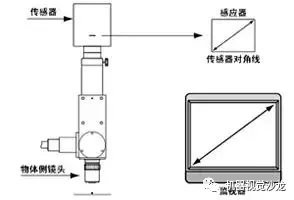
※ Sometimes the above simple calculation will have some changes depending on the scanning status of the TV monitor.
28. Field of view (FOV):
The field of view refers to the range of the object side that can be seen after using the camera.
Longitudinal length of the camera's effective area (V)/Optical magnification (M) = Field of view (V)
Horizontal length of the camera's effective area (H)/Optical magnification (M) = Field of view (H)
Longitudinal length of the camera's effective area (V) or (H) = the size of one pixel of the camera × the number of effective pixels (V) or (H) to calculate.
(Calculation example) Optical magnification=0.2x, CCD size 1/2" (length 4.8mm, width 6.4mm}:
field of view size length=4.8/0.2=24(mm)
width=6.4/0.2=32{mm)
29. Resolution:
The interval between two points that can be seen is 0.61x. The wavelength used (λ)/NA=resolution (μ). The above calculation method can theoretically calculate the resolution, but does not include distortion. ※The wavelength used is 550nm
30. Resolution:
The number of black and white lines can be seen in the middle of 1mm. Unit (lp)/mm
31. MTF (Modulation Transfer Function):
The spatial frequency and contrast used to reproduce the shading changes on the surface of an object during imaging.
32. Imaging circle:
Image size φ, you need to enter the camera sensor size
33. Camera Mount:
C-mount: 1" diameter x 32 TPI: FB: 17.526mm, CS-mount: 1" diameter x 32 TPI: FB: 12.526mm, F-mount: FB:46.5mm, M72-Mount: FB. Manufacturers vary. .
34. Edge brightness:
Relative illumination refers to the percentage of central illumination to peripheral illumination.
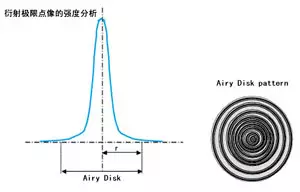
35. Ventilation disc and resolution:
Airy Disk refers to the concentric circles formed when light is focused on one point through a lens without distortion. This concentric circle is called Airy Disk. The radius r of Airy Disk can be calculated by the following formula. This value is called resolution. r = 0.61λ/NA The radius of Airy Disk changes with the wavelength. The longer the wavelength, the harder it is to focus light on one point. Example: NA0.07 lens wavelength 550nm r = 0.61*0.55/0.07 = 4.8μ
36. MTF and resolution:
MTF (Modulation Transfer Function) refers to the change in light and dark on the surface of an object, and the image side is also reproduced. It indicates the imaging performance of the lens and the degree of contrast of the object reproduced by the image. To test the contrast performance, a black and white interval test with a specific spatial frequency is used. The spatial frequency refers to the degree of light and dark change at a distance of 1mm.
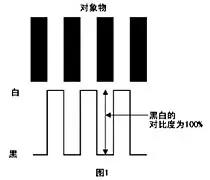
As shown in Figure 1, black and white matrix waves, the contrast of black and white is 100%. After this object is photographed by the lens, the change in the contrast of the image is quantified. Basically, no matter what lens, there will be a decrease in contrast. Eventually the contrast is reduced to 0%. , color distinction cannot be made.
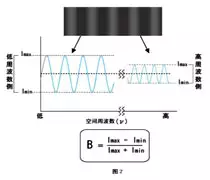
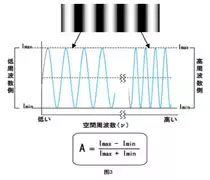
Figures 2 and 3 show the changes in spatial cycle number between the object side and the imaging side. The horizontal axis represents the spatial frequency, and the vertical axis represents the brightness. The contrast between the object side and the imaging side is calculated from A and B. MTF is calculated from the ratio of A and B.
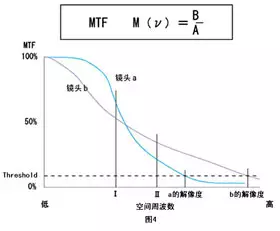
Relationship between resolution and MTF: Resolution refers to the distance between two points. Generally, the quality of a lens can be judged from the value of resolution, but in fact, MTF has a great relationship with resolution. Figure 4 shows the MTF curves of two different lenses. Lens a has low resolution but high contrast. Lens b has low contrast but high resolution.
Thirty-seven. Macro lens:
Enlarged photography is achieved without close-up rings or close-up lenses. Lenses designed for close-up photography have a limited focal length (= light emitted from the objective lens is focused at a certain distance).
38. CCTV Camera:
Suitable for wide-range enlarged observation, not suitable when strict accuracy is required, infinity (= light emitted from the objective lens, unfocused, parallel progression)
39. Zoom lens:
The focal length variable lens can easily change the magnification, shooting range, etc. It is suitable for use in situations where you need to find the most suitable shooting conditions (shooting distance, lens focal length) for easy operation. The lens that does not produce focus position movement is called a variable magnification lens, and the lens that produces focus position movement is called a zoom lens.
40. Image circle:
The size of the imaging circle in the optical system, the size of the imaging circle = the diagonal size of the CCD, has the same meaning as the CCD size.
41. Rear zoom lens:
Installed in front of the CCD, it does not change the working distance and expands the field of view. The F value decreases, the resolution and contrast decrease, and the focus will be somewhat inaccurate.
42. Front zoom lens:
Installed in front of the lens, the working distance will change, the brightness will remain unchanged, and the field of view will be expanded