
The lens is equivalent to the role of a pinhole in pinhole imaging. The difference is that on the one hand, the light-transmitting aperture of the lens is many times larger than the small hole, and can accept more light in the same time, allowing the camera to obtain appropriate exposure in a very short time (milliseconds to seconds); on the other hand, On the one hand, the lens can focus the light beam and produce a clearer image on the camera film than the pinhole imaging effect.
Lens composition:
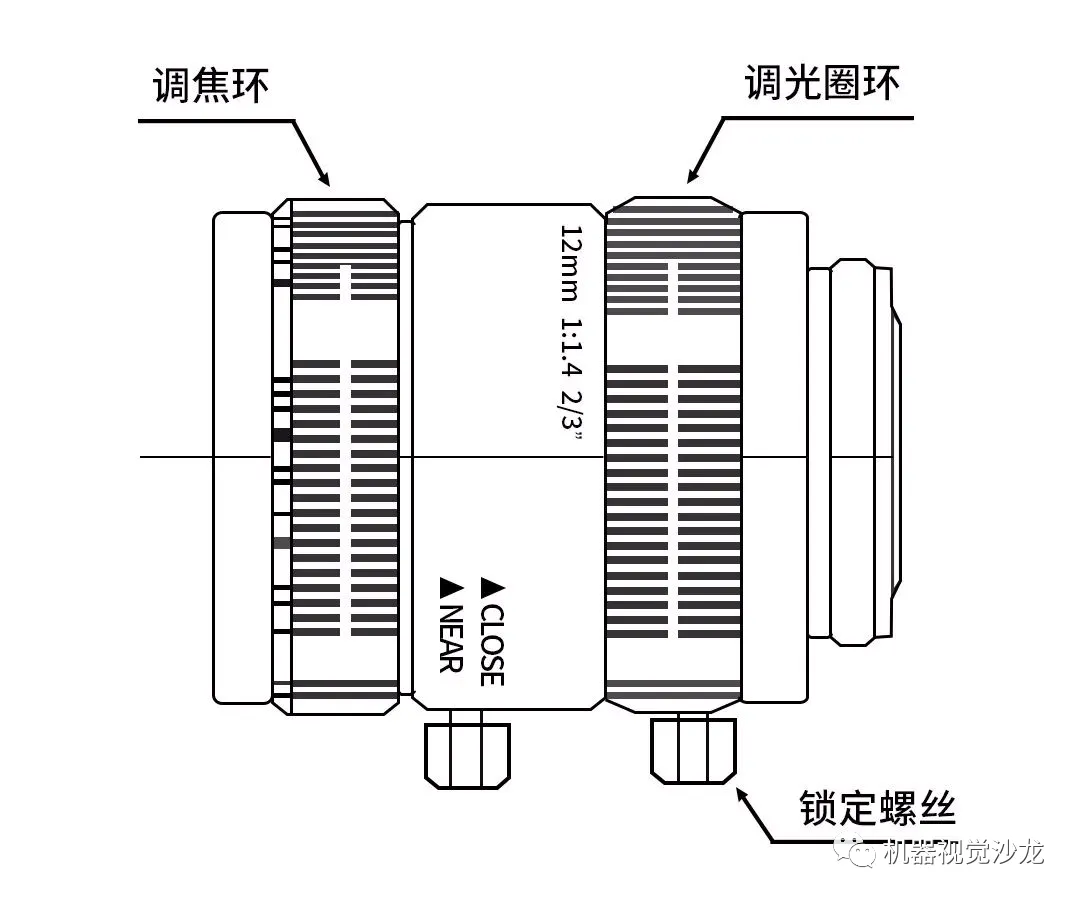
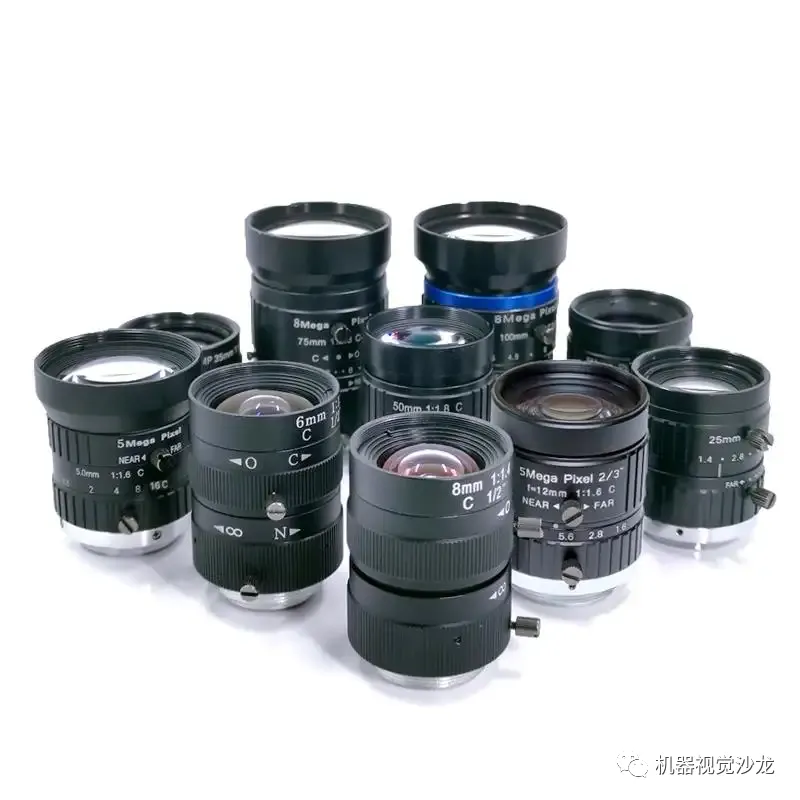
Fixed-focus lenses are commonly used in machine vision, and the aperture is adjusted manually. Automatic aperture adjustment is generally not allowed. There are two rings on the lens: the focus ring and the aperture ring. In order to prevent accidental movement, the two rings of the industrial lens have locking screws.
Note that the focus ring is not used to adjust the focal length, but to adjust the image distance to ensure that a clear image falls on the focal plane.
Industrial lens interface:
There are three international standards for objective lens interfaces:
-
F interface
-
C-Mount
-
CS interface
The F mount is a universal mount, generally suitable for lenses with a focal length greater than 25mm. When the focal length of the objective lens is less than 25mm, the size of the objective lens is not large, and a C-type or CS-type mount is generally used.
The difference between C and CS type interfaces:
The difference between C and CS type interfaces lies in the distance from the contact surface between the lens and the camera (reference plane) to the focal plane of the camera (the location of the camera's CCD photoelectric sensor), that is, the flange distance is different. The flange distance of the C type interface is 17,562mm. The CS type interface flange distance is 12.5mm.
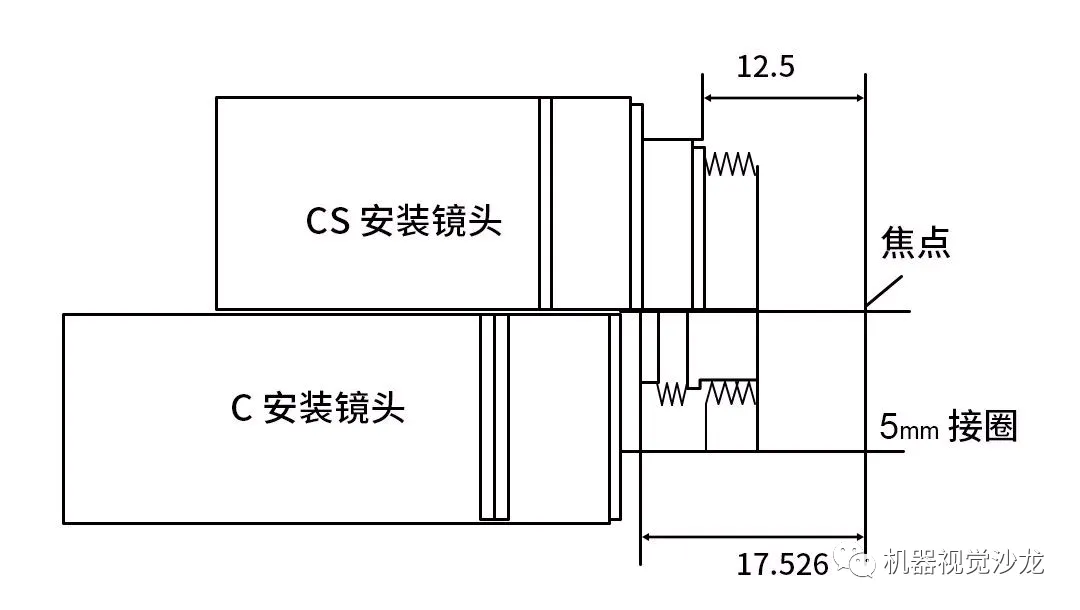
A 5mm C/CS adapter ring can be added between the C-mount lens and the CS-mount camera to enable them to be used together. The CS-mount lens and the C-mount camera cannot be used together.
Basic parameters of industrial lenses
Field of View: Field of View, FOW, also called field of view, refers to the visual range of objects that can be observed.
Working Distance: Working Distance refers to the distance from the front of the lens to the surface of the object being inspected, at which the lens can produce a clear image.
Resolution: Resolution refers to the ability of a lens to clearly distinguish the details of a photographed object. The number of pairs of black and white lines that can be distinguished within 1mm of the image plane. The unit of resolution is "line pair/mm" (lp/mm). Generally speaking, a megapixel lens has a resolution of 100 line pairs/mm.
Depth of View : In the scene space, the vertical distance within a certain distance before and after the focusing plane that can still produce a clear image, that is, the simplified depth range of the scene for obtaining a relatively clear image on the actual image plane.
Focal Length: Focal Length , the focal length is the distance from the center point of the lens to the clear image formed on the focal plane. The focal length is small, the viewing angle is large, and the observed range is also large, but the image of distant objects is not very clear. , the focal length is large, the viewing angle is small, and the observation range is small, but distant objects can also be clearly imaged. There are two lens models: fixed focus and zoom. Common industrial lens focal lengths are: 5mm, 8mm, 12mm, 25mm, 35mm, 50mm, 75mm, etc. Generally speaking, the smaller the focal length, the more expensive the price.
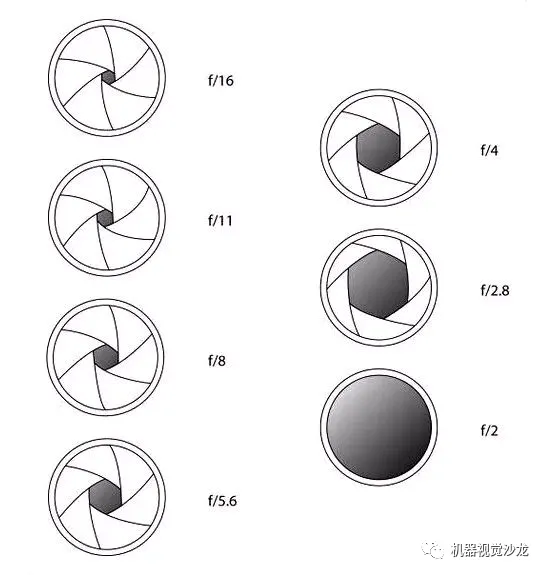
Aperture: Iris is a device used to control the amount of light that passes through the lens and enters the photosensitive surface inside the camera body. When shooting high-speed moving objects, a large aperture is required due to the short exposure time. The aperture size is generally expressed as F, which is measured by the ratio of the lens focal length f and the aperture diameter D. When the physical aperture of the aperture remains unchanged, the farther the distance between the lens center and the photosensitive device, the larger the F value and the smaller the aperture; conversely, the smaller the F value, the larger the aperture. The aperture is generally adjusted by adjusting the aperture size. The complete aperture value series is as follows: F1, F1.4, F2, F2.8, F4, F5.6, F8, F11, F16, F22, F32, F44, F64.
 .
.
Every increase in the aperture F value means that the area of the light-transmitting aperture, or the amount of light entering, is reduced by half.
Maximum compatible CCD size:
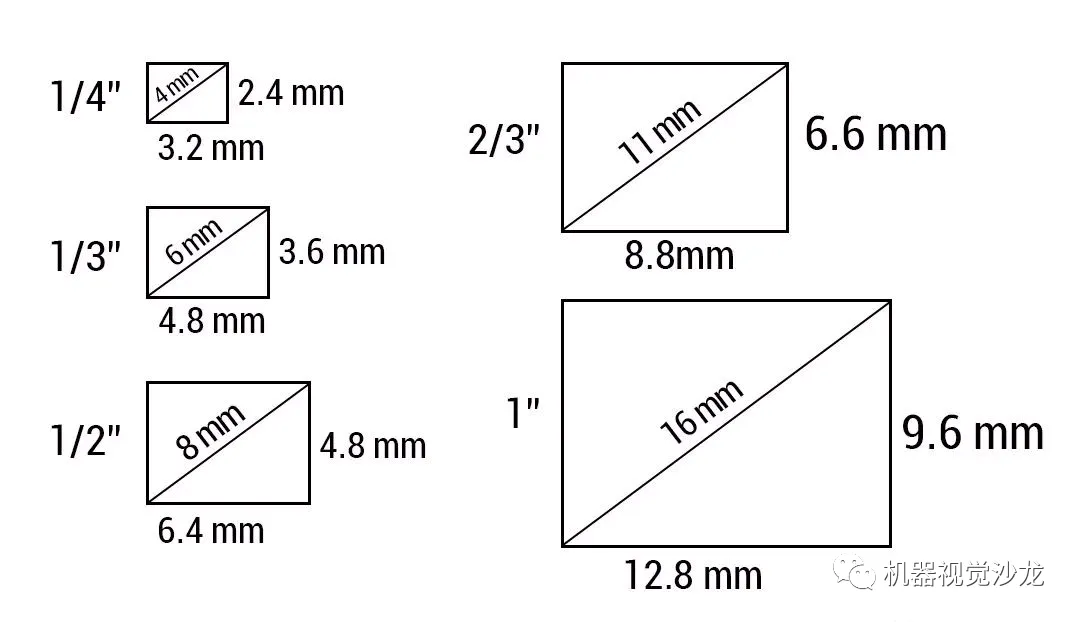
All lenses can only produce clear images within a certain range. The maximum compatible CCD size refers to the maximum range of clear images that the lens can support. When choosing a camera and lens in practice, it is important to note that the maximum compatible CCD size of the selected lens must be greater than or equal to the size of the camera chip.
The size of the CCD chip is shown in the figure below:
lens distortion
When a lens forms an image, the image will be deformed, which is called lens distortion.
Lens distortion is caused by the optical structure and imaging characteristics of the lens, and generally includes barrel distortion and pincushion distortion. Inconsistent local magnification in the field of view can cause image distortion. The larger the shooting field of view and the shorter the focal length of the lens used, the more obvious the degree of distortion. This plane distortion can be reduced through image calibration.
Lens selection:
-
When choosing based on field of view, optical magnification, and desired working distance, we would select a lens that is slightly larger than the field of view of the object being measured to facilitate motion control.
-
For projects that require depth of field, use a small aperture as much as possible; when choosing a magnification lens, use a low-magnification lens as much as possible if the project permits. If the project requirements are more demanding, we tend to choose cutting-edge lenses with high depth of field.
-
Chip size and camera interface: For example, a 2/3” lens supports a maximum industrial camera rake surface of 2/3”, and it cannot support industrial cameras larger than 1 inch.
-
Pay attention to the coordination with the light source and choose the appropriate lens.
Photography related
shutter
The shutter is a device in the camera that controls the exposure time. The exposure time is the time from the shutter opening to closing. Long exposure time means more light entering, which is suitable for poor light conditions. Short exposure time means better light conditions.
ISO
Sensitivity is the sensitivity of the camera to light. Under the same light conditions, the higher the ISO value, the shorter the required exposure time. High ISO takes pictures faster, but the noise also increases; low ISO takes pictures with high quality, but the exposure time required increases and the picture is easily blurred.
To ensure image quality, you should try to use a low ISO when shooting, and control the exposure by adjusting the aperture and shutter speed (exposure time).