Industrial Lenses
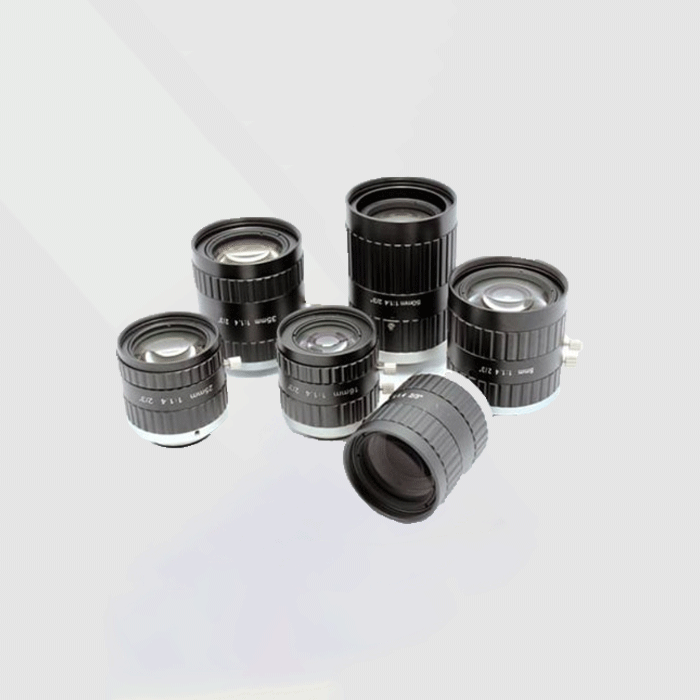
In a machine vision system, the lens focuses the optical image of the target on the photosensitive array of the image sensor (camera). All image information processed by the visual system is obtained through the lens.
Do you know the relevant professional terms for machine vision industrial lenses?
telecentric optical system
Refers to an optical system in which the chief ray is parallel to the optical axis of the lens. If the light from the lens to the image remains parallel to the optical axis, even outside the axis, it is called an image-side telecentric optical system.
distortion
In the lens optical system, the position where the image is formed and the image magnification vary with the wavelength of the light. Different wavelengths of light have different colors, which is called color distortion . The difference in magnification is called magnification color distortion.
Working distance (WD)
Working distance refers to the distance from the first working surface of the lens to the object being measured.
Distance between object and image O/I
O/I refers to the distance from the object to the image plane.
Resolution (μm)
The measure of optical system capability, indicating the maximum number of pairs of black and white stripes that can be observed in 1mm when a black and white grid pattern is observed through the lens. Resolution is the measurement of the closest distance between two points before they cannot be recognized.
Focal length f (mm) back focal length/front focal length
The focal length is the distance from the main light point to the focal point of the optical system . The distance from the vertex of the last lens to the back focus is the back focal length ; the distance from the vertex of the first lens to the front focus is the front focal length .
Telecentric lens
Two-sided telecentric head : The main object side and the image side both have main rays parallel to the optical axis. The aperture is variable and can obtain a high depth of field. It can obtain a more stable image than the object-side telecentric head. It is most suitable for image processing optics for measurement. system, but the large-scale cost is high.
Object-direction telecentric view : Only the principal light ray of the object-direction is parallel to the main axis of the lens. If the workpiece changes up and down, the size of the image will basically not change. It is a necessary condition when using coaxial epi-illumination, and it can also be adapted to miniaturization.
Image-side telephoto lens : The image-side chief ray is parallel to the lens optical axis. Even if there is individual installation difference on the camera side, it can absorb the change of photographic magnification for color shift compensation. Cameras should all use this type of lens.
Characteristics of telecentric and non-telecentric optical systems
Non-telecentric : Advantages: Smaller size. Fewer lenses, lower cost. Disadvantages: Changing the size or position of the object when moving it up and down the surface.
Object-side telecentric : Advantages: Does not change object size or position when moving up and down the object surface. Can use smaller size with coaxial illumination. Disadvantages: Larger than standard lens size when coaxial illumination is not used.