logo

Machine Vision Light Source Color Selection Strategy

The machine vision system is composed of industrial lenses, industrial cameras, visual light sources, software systems, etc. The role of the light source is to clearly distinguish the object being measured from the background and obtain high-quality images. It plays an important role in the visual system. Choosing a suitable light source is an important part of building a visual system.
Machine vision light sources come in many types and colors. How should we choose?

1

Machine Vision Light Source Color


White light source (W): White light source is usually defined by color temperature. Colors with high color temperature are bluish (cold color temperature > 5000K), colors with low color temperature are reddish (warm color temperature < 3300 and 5000K), and the colors in between are called intermediate colors. White light source has wide applicability and high brightness, and is used more when shooting color images.
Blue light source (B): The wavelength of blue light source is between 430-480. Applicable products: products with silver background (such as sheet metal, machined parts, etc.), metal prints on films.
Red light source (R): The wavelength of red light source is usually between 600-720, which can penetrate some darker objects, such as hole positioning of transparent soft board with black substrate, circuit detection of green circuit board, thickness detection of transparent film, etc. Using red light source can improve contrast.
Green light source (G): The wavelength of greenlight source is 510-530, which is between red and blue. It is mainly used for products with red background and silver background.

02

Tips for choosing light source color
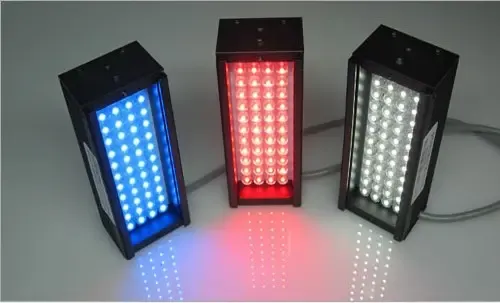
 

There are many types of machine vision light sources. Choosing a reasonable light source color can produce sufficient grayscale value difference between the features and the surrounding areas.
When choosing a visual light source, many parameters such as angle, shape, brightness, color, etc. are involved. In order to distinguish objects from the background to the greatest extent, a color complementary light source is usually selected.
Choosing a reasonable light source color can produce sufficient grayscale difference . Generally speaking, if a black and white camera is used and there is no special requirement for the color selection of the object being measured, red is a more appropriate choice.
Because red LEDs have a long life, are stable, and are inexpensive, and more importantly, the wavelength of red LEDs is closer to the peak sensitivity of the sensor, while ordinary CCDs are not as sensitive to purple and blue light as they are to red light.
If color imaging is performed, a white light source is usually considered.
There are several methods to manufacture white LED light sources. One is to use white LEDs . There are blue light-emitting chips and fluorescent powders that emit yellow light when excited inside the light-emitting tube. The emitted light is superimposed in a certain proportion, forming a white color. This is the most common form.
Another method is to use three different color LEDs , red, green and blue, arranged on the light source in a certain order or way, and control the intensity of each color separately, which is relatively convenient to use. This method usually uses four single-color RGGB particles for arrangement, so the green component is usually sufficient. The reason for adding an extra green G flux is that the human eye is most sensitive to green light sources (wavelength 555nm).
In machine vision applications, attention should be paid to the matching of target color and light source color. We see an object as a certain color because it reflects the corresponding spectrum. When we shoot an object, if we want to make a certain color white, we have to use a light source that is the same or similar to this color (the wavelength of light is the same or close), and if we want to make it black, we need to choose a light source with a larger wavelength difference from the target color.
In visual applications, rationally selecting the color of the light source for the target color helps reduce algorithm difficulty and improve system stability.

Similar colors

Similar colors refer to colors with the same hue properties but different shades of chroma.
It is the color within the 15° angle on the color wheel.
Such as dark red and light red, dark blue and light blue.

Adjacent colors

Adjacent colors are colors that are adjacent to each other on the color band.
For example, red and orange.
In the color wheel, all colors within the 60-degree range belong to the adjacent color range.

Complementary/contrasting colors

There is a very strong contrast, and when the color saturation is high, many very shocking visual effects can be created.
For example, orange and blue, red and green, yellow and purple.
The color opposite (180 degrees diagonally) each color on the color wheel.

Analogous colors

Analogous colors are three colors that are adjacent to each other on the color wheel.
Colors within a 90-degree angle on the color wheel are collectively called analogous colors.
For example, red - red-orange - orange, yellow - yellow-green - green, cyan - cyan-purple - purple, etc. are all similar colors.

03

Case Analysis


Under a color camera, except for black and gray, the lines are not obvious, while others such as white, purple, blue, green, yellow, orange, red, brown, etc. are obvious and full of bright colors.
Large-scale imaging of multi-color cables with a black-and-white camera under white light shows that the white, yellow, green, and orange colors are brighter, indicating that the camera is more sensitive to these wavelengths.
When imaging under red light, white, red, orange and yellow are more obvious, while other colors are very dark. This means that when red light shines on an object, the object itself can only reflect red light if it has a red component, which appears as a red feature under a black and white camera.
When the lines are arranged in a black and white camera with a green light source, white, green and yellow appear bright, while other colors appear darker.
Under a blue light source, the white, purple, and blue lines are brighter, effectively reflecting blue light. It can also be seen that no matter what light it is shining on, the white line forms a clear white color because it does not absorb the light spectrum itself, and any light spectrum that shines on its surface will be reflected. In contrast, black materials do not reflect black when illuminated.
In addition, in diffraction, the width of the diffraction fringe is proportional to the wavelength. For example, the half-angle width of the central plane fringe of a single slit diffraction is sintheta = λ/a, where λ is the wavelength and a is the width of the single slit diffraction.
In photography, surfaces are usually not very smooth, causing diffraction, so diffraction is stronger with red light than with blue light. Therefore, red light is usually used to get more surface detail, while blue light is used to get more contrast.
The resolution formula of the lens is 0.61/NA, where λ is the wavelength and NA is the numerical aperture.
It can be seen that when the NA is fixed and different wavelengths and colors of light are used, the resolution of the lens is different. Therefore, when using the same light source, the resolution of the same lens in blue light is usually higher than that in red light.

KNOWLEDGE CENTER