
Editor’s Note:
A complete visual inspection system mainly includes image acquisition and image analysis. The image acquisition part is mainly undertaken by industrial cameras, industrial lenses and machine vision light sources. Today we mainly introduce the basic knowledge and selection techniques of machine vision light sources.
First of all, we need to understand what role the light source plays in machine vision:
1. Illuminate the target and increase brightness;
2. Create an imaging effect that is beneficial to image processing, reduce the complexity of the system and the requirements for image processing algorithms;
3. Overcome ambient light interference, ensure image stability, and improve system accuracy and efficiency.
Appropriate light source lighting design can achieve the best separation of target information and background information in the image, which not only greatly reduces the difficulty of image processing algorithms, but also improves the accuracy and reliability of the system. Unfortunately, there is currently no universal machine vision lighting system to meet different detection requirements. Therefore, for each specific case, a suitable lighting device needs to be designed to achieve the best effect. Inappropriate lighting will cause many problems. Machine vision light sources are so important, but they are often overlooked by many people.
At present, the main light source for machine vision is LED (light emitting diode) , which is widely used in the industry due to its high shape freedom, long service life, fast response speed, good monochromaticity, diverse colors, and high comprehensive cost performance.
1. Shape freedom
An LED light source is composed of many individual LEDs, so compared with other light sources, it can be made into more shapes, and it is easier to design the shape and size of the light source according to the user's situation.
2. Long service life
In order for the image processing unit to obtain accurate and repeatable measurement results, the lighting system must ensure that it can provide stable image input for a considerable period of time. The brightness of the LED light source will decay after 10,000 to 30,000 hours of continuous operation, but it is much better than other light sources. In addition, using a control system to make it work intermittently can suppress the heat generation of the light-emitting tube and double its life.
3. Fast response speed
The response time of LED light-emitting tubes is very short. The real meaning of response time is to ensure the working switching between multiple light sources or different areas of one light source as required. When a dedicated controller is used to power the LED light source, the time to reach maximum illumination is less than 10s.
4. Diverse colors
In addition to the shape of the light source, another aspect of obtaining a stable image input is to select the color of the light source. Even for light sources of the same shape, the images obtained will be very different due to different colors. In fact, how to use the technical characteristics of the light source color to obtain the best contrast image effect has always been the main direction of light source development.
5. Low comprehensive operating costs
If you choose cheap products with no guaranteed performance, the initial investment savings will soon be offset by daily maintenance and repair costs. Other light sources not only consume 2 to 10 times more power than LED light sources, but also need to be replaced almost every month, wasting a lot of precious time for maintenance engineers. Moreover, the more light sources are put into use, the greater the cost of device replacement and labor, so choosing LED light sources with long life is very economical in the long run.
Basic knowledge of machine vision lighting technology:
1) Irradiation method
Choosing different light sources, controlling and adjusting the direction of incident light on the object is the most basic parameter in the design of a machine vision system. It depends on the type of light source and its position relative to the object. Generally speaking, there are two most basic methods: direct light and diffuse light. All other methods are derived from these two methods.
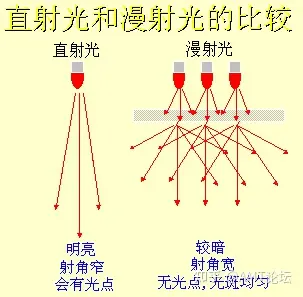
Direct light: The incident light basically comes from one direction with a small angle, and it can cast a shadow on an object;
Diffuse light: incident light comes from multiple directions, or even all directions, and it does not cast obvious shadows.
2) Reflection method
There are two different reflection characteristics when objects reflect light: direct reflection and diffuse reflection.
Direct reflection: The reflection angle of the light is equal to the incident angle. Direct reflection is sometimes very useful, but sometimes it may produce extremely strong glare. In most cases, specular reflection should be avoided.
Diffuse reflection: Light that strikes an object is scattered in all directions. In most practical cases, the scattered light is formed within a certain range of angles and depends on the angle of the incident light.
3) Color
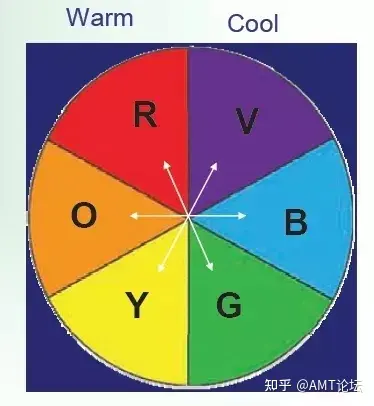
A large part of the electromagnetic spectrum is visible to the human eye. Electromagnetic radiation in this wavelength range is called visible light, which ranges from 400nm to 760nm (some people can observe 380~780nm), that is, from violet 380nm to red 780nm.
The color wheel is to sort the colors in the visible light spectrum, forming red connected to purple at the other end. The color wheel used in machine vision usually includes 6 different colors, which are divided into two categories: warm colors and cool colors. Warm colors are composed of red tones, and cool colors come from blue tones. Usually, the image can achieve the highest level of contrast when illuminated by light of opposite color temperature; light of the same color temperature can effectively filter out. Therefore, flexible use of color temperature characteristics is very helpful for us to choose light sources.
4) Bright field and dark field
Bright field is the most commonly used lighting scheme, which is formed by direct frontal light. Dark field is mainly formed by low-angle or backlighting. Different types of lighting methods are selected for different project inspection requirements. Generally speaking, dark field will make the background appear dark, while the inspected object will appear bright.
5) Light source classification
There are currently several main classification methods:
a) Color
Commonly used light source colors are concentrated in the visible light range, mainly white light (composite light), red, blue, and green. Infrared light is also relatively popular, while ultraviolet light is less used due to various reasons.
b) Appearance
Each manufacturer will classify the light sources according to their appearance characteristics, which is also the current mainstream classification, such as ring light sources, ring low-angle light sources, strip light sources, dome light sources (bowl light sources/dome light sources), surface light sources, etc.
c) Working principle/characteristics
According to different application methods or principles, there are mainly shadowless light sources, coaxial light sources, point light sources, line light sources, backlight sources, combined light sources and structured light sources.
Common light source types and lighting methods
1. General purpose lighting (direct lighting): Light is directed directly at the object to obtain a clear image.
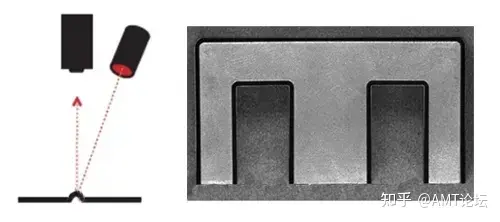
This type of light is effective when we need to get a high-contrast image of an object. But when we use it to shine on shiny or reflective materials, it will cause mirror-like reflections. General lighting generally uses ring or point lighting. Ring light is a common general lighting method that is easy to install on the lens and can provide sufficient illumination for diffuse reflective surfaces.
2. Darkfield lighting: Darkfield lighting provides low-angle lighting relative to the surface of an object.
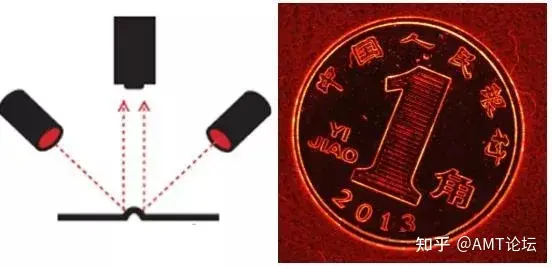
When shooting a mirror with an industrial camera, if the light source can be seen in the field of view, it is considered bright field lighting. On the contrary, if the light source cannot be seen in the field of view, it is considered dark field lighting. Therefore, whether the light source is bright field lighting or dark field lighting is related to the position of the light source. Usually, dark field lighting is used to illuminate the protruding parts of the surface or the changes in the surface texture.
3. Backlighting: Light with a uniform field of view is emitted from the back of the object, and the side profile of the object can be seen through the camera.
Backlighting is often used to measure the size and orientation of an object. Backlighting creates a strong contrast. When backlighting is applied, surface features of the object may be lost. For example, you can measure the diameter of a coin using backlighting, but you cannot tell which side is which.
4. Diffuse lighting: Continuous diffuse lighting is applied to objects with reflective surfaces or surfaces with complex angles.
Continuous diffuse lighting applies uniform illumination in a hemispherical pattern to reduce shadows and specular reflections. This type of lighting is very useful for fully assembled circuit boards. This light source can achieve uniform illumination over a solid angle range of 170 steradians.
5. Coaxial lighting: The formation of coaxial light - divergent light coming out through the vertical wall, hits a beam splitter that directs the light downward, and the camera looks at the object through the beam splitter from above.
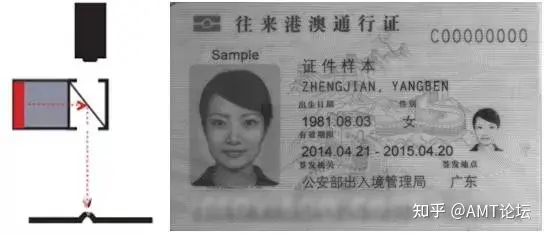
This type of light source is particularly helpful for detecting highly reflective objects, and is also suitable for detecting objects with unclear areas under the influence of shadows from the surrounding environment.
6. Polarizer: Only allows light with vibration direction parallel to its allowed direction to pass through, and the perpendicular component is cut off.
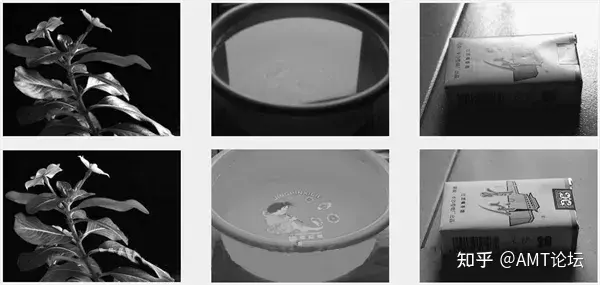
For specific applications, choosing the best lighting system from a variety of options is the key to the stable operation of the entire image processing system.