
Global Agents Wanted! Join us to share market opportunities. Comprehensive training, technical support, and attractive incentives provided. Act now for a brilliant future! Contact email: partners@falenses.com
A team led by Professor Dexin Ye and Professor Hongsheng Chen from Zhejiang University, along with Professor Yu Luo from Nanyang Technological University, conducted practical research on full-parameter transformation optical devices. The research team designed and realized a full-parameter omnidirectional invisibility cloak based on linear transformation optics and omnidirectional matching transparent metamaterials, capable of hiding large objects in free space.
The study, titled "Full-Parameter Omnidirectional Transformation Optical Devices," was published in the "National Science Review." Dr. Yuan Gao from Zhejiang University is the first author, with Professors Yu Luo, Hongsheng Chen, and Dexin Ye as the corresponding authors.
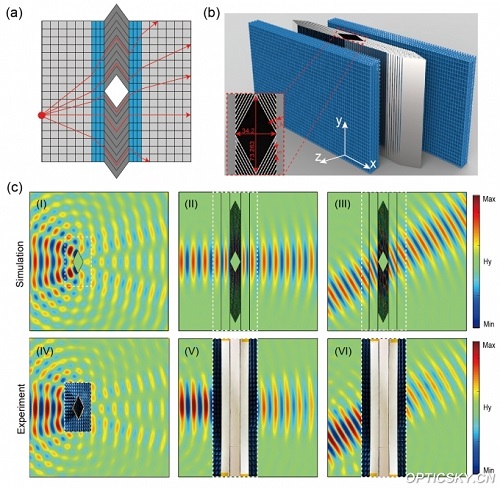
Designing the ideal omnidirectional cloak in free space involves: (a) a stealth design based on linear transformation optical elements; (b) a schematic diagram of the actual cloak; and (c) simulations (I, II, III) and measurements (IV, V, VI) of the stealth performance.
In 2006, Professor Pendry from Imperial College London proposed transformation optics, describing the relationship between electromagnetic wave propagation paths and material constitutive parameters, providing a general and powerful method for controlling electromagnetic waves.
Over the past decade, transformation optics has developed rapidly, leading to the design of various novel optical devices, such as invisibility cloaks, electromagnetic illusion devices, and concentrators. However, the constitutive parameters of transformation optics media are anisotropic and often non-uniform or have singular values, making them difficult to implement.
For example, previous experiments with omnidirectional invisibility cloaks always made some simplifications to the material parameters, compromising impedance matching and reducing the performance of transformation optical devices.
To address these issues, the research team designed a two-dimensional full-parameter omnidirectional planar invisibility cloak based on linear transformation optics, consisting of only two types of homogeneous materials. The constitutive parameters of the first material are anisotropic, with both zero and extreme values, allowing electromagnetic waves propagating along the optical path to have infinite phase velocity.
Using this material, electromagnetic waves can bypass the invisible region, achieving omnidirectional impedance matching and zero phase delay. The second material also has anisotropic constitutive parameters, allowing phase compensation under omnidirectional impedance matching, and has sub-wavelength phase velocity for electromagnetic waves propagating along the optical path.
In experimental validation, the researchers used these two types of materials with full-parameter constitutive parameters for TM polarized waves. The first material was implemented with sub-wavelength metallic patch arrays exhibiting Fabry-Perot resonance, while the second material was implemented with traditional I-type electric resonators and split-ring resonators.
Finally, the researchers measured the surrounding magnetic field at different angles with TM polarized waves incident on the full-parameter omnidirectional cloak, composed of the two aforementioned materials, demonstrating excellent stealth performance.
This study is the first to showcase a full-parameter omnidirectional invisibility cloak in free space, capable of hiding large objects under any incident light. The implemented cloak can be immediately used to suppress the radar cross-section and bistatic detection in communication and surveillance systems.
The proposed method also has significant implications for the practical application of other full-parameter transformation optical devices.
FALenses Technology specializes in providing machine vision core hardware. You can go to the official website of FALenses Technology at https://www.falenses.com/ for more information.