
Global Agents Wanted! Join us to share market opportunities. Comprehensive training, technical support, and attractive incentives provided. Act now for a brilliant future! Contact email: partners@falenses.com
For centuries, it has been known that light exhibits wave-like behavior under certain conditions. When light passes through certain materials, they can change the polarization (i.e., the oscillation direction) of light waves. Core components of optical communication networks, such as "optical isolators" or "optical diodes," leverage this property to allow light to travel in one direction while blocking it in the other.
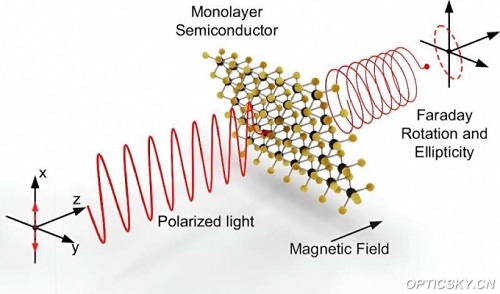
Image Caption: Faraday effect in 2D semiconductors
In a recent study, physicists from Germany and India have shown that ultrathin two-dimensional materials, such as tungsten diselenide, can rotate the polarization of certain wavelengths of visible light by several degrees under small magnetic fields suitable for use on a chip. Scientists from the University of Münster in Germany and the Indian Institute of Science Education and Research (IISER) in Pune, India, published their research findings in the journal "Nature Communications."
One of the issues with traditional optical isolators is their relatively large size, typically ranging from a few millimeters to a few centimeters. As a result, researchers have yet to create miniature integrated optical systems on chips that can rival everyday silicon-based electronics in terms of compactness. Current integrated optical chips contain only a few hundred components, while computer processors contain billions of switching elements.
In contrast, the research by the German and Indian teams represents a step forward in developing miniature optical isolators. The 2D materials used are only a few atomic layers thick, making them about 100,000 times thinner than a human hair.
Professor Rudolf Bratschitsch from the University of Münster said, "In the future, 2D materials could become the core of optical isolators, enabling on-chip integration of today's optics and future quantum optics for computing and communication technologies."
Professor Ashish Arora from IISER added, "Even the bulky magnets required for optical isolators could be replaced with atomically thin 2D magnets, greatly reducing the size of photonic integrated circuits."
The research team deciphered the mechanism that leads to the observed effect: bound electron-hole pairs, known as excitons, in 2D semiconductors can cause strong rotation of light polarization when the ultrathin materials are placed in a small magnetic field.
Arora noted, "Conducting such sensitive experiments on 2D materials is not easy due to the very small sample area. Scientists had to develop a new measurement technique that is about 1,000 times faster than previous methods."
Source: Phys.org
FALenses Technology specializes in providing machine vision core hardware. You can go to the official website of FALenses Technology at https://www.falenses.com/ for more information.