
Global Agents Wanted! Join us to share market opportunities. Comprehensive training, technical support, and attractive incentives provided. Act now for a brilliant future! Contact email: partners@falenses.com
According to MEMS Consulting, traditional ellipsometers (Figure 1a) utilize mechanical rotating polarizers and grating-based spectrometers for spectral polarization detection. This makes these systems relatively complex, large, and time-consuming to operate.
To address these challenges, a research team led by Associate Professor Yang Yuanmu from the Department of Precision Instrumentation at Tsinghua University proposed a compact spectroscopic ellipsometry system based on a metasurface array, enabling single-shot spectral polarization detection and precise thin film characterization without any mechanical movement. The approach combines silicon-based metasurface arrays with high anisotropy and diversified spectral responses with iterative optimization to reconstruct the full Stokes polarization spectrum of reflected light from a thin film with high fidelity. The reconstructed spectrum can then be used to derive the ellipsometric parameters to determine film thickness and refractive index through high-precision fitting to a suitable material model. This method opens a new path for developing compact, robust, high-throughput spectroscopic ellipsometry systems for characterizing thin film properties. The research results were recently published in the journal "Light: Science & Applications" under the title "Metasurface array for single-shot spectroscopic ellipsometry."
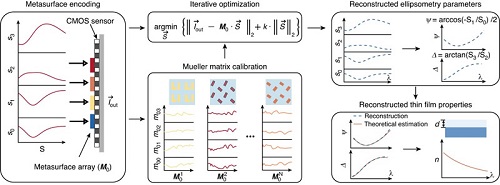
The detailed working principle of the metasurface array-based spectroscopic ellipsometer is illustrated in Figure 2. This prototype consists of a single-layer metasurface array integrated on top of a CMOS image sensor. The Mueller matrix (M0) of the metasurface array is pre-calibrated. The full Stokes polarization spectrum of the incident light can be reconstructed through convex optimization with l2 regularization. Subsequently, by fitting the reconstructed spectrum to a multi-beam interference model, the ellipsometric parameters can be derived to determine the thin film's thickness (d) and refractive index (n).
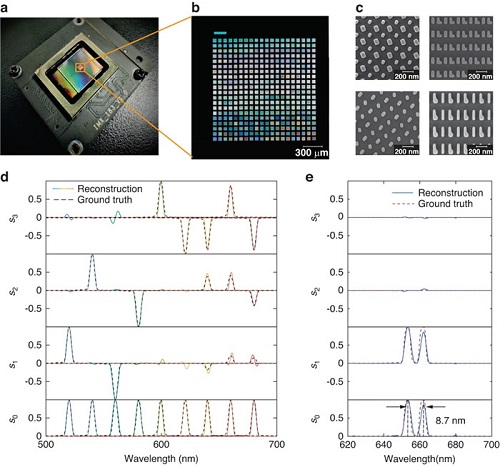
In this architecture, the key to accurately reconstructing the ellipsometric parameters and thin film properties is to design a metasurface array with high anisotropy and diversified spectral characteristics to minimize the correlation coefficients of each row in the Mueller matrix. In this study, each of the 20 × 20 elements in the metasurface array consists of 300 nm-thick silicon nanostructures on a sapphire substrate. The geometry of each element is optimized to minimize the correlation coefficients between different elements in the M0 matrix.
To experimentally demonstrate the performance of the spectroscopic polarization detection system based on the metasurface array, the researchers assembled a prototype (Figure 3a), with a 20 × 20-element array measuring 1.5 mm × 1.5 mm in total. The metasurface array was fabricated on a sapphire substrate using standard electron beam lithography (EBL) and reactive ion etching (RIE) processes. The array was integrated onto a CMOS image sensor (Sony IMX-183) using a 5 µm-thick optically transparent tape. The researchers then evaluated the system's spectral polarization reconstruction performance and its ability to resolve fine spectral features (Figure 3d and 3e).
Finally, to experimentally demonstrate the spectroscopic ellipsometry measurements, the researchers selected five SiO2 thin films with thicknesses ranging from 100 nm to 1000 nm deposited on a silicon substrate as test samples. White light from a halogen lamp, passing through a 45° linear polarizer and incident at a 60° angle on the thin film sample, was used for illumination, with reflection angles close to Brewster's angle to ensure significant polarization conversion. The reflected light was incident vertically onto the metasurface array. The reconstructed full Stokes polarization spectra for the 100 nm and 1000 nm SiO2 thin films were compared to traditional measurements, showing excellent consistency.
Overall, this study proposed and experimentally demonstrated a new compact spectroscopic ellipsometry system based on a metasurface array for single-shot measurement of thin film properties. Unlike traditional spectroscopic ellipsometers, the proposed system does not require mechanical moving parts or phase modulation components, allowing high-throughput in-line measurements of thin film properties in semiconductor processing, such as in thin film etching or deposition systems.

FALenses Technology specializes in providing machine vision core hardware. You can go to the official website of FALenses Technology at https://www.falenses.com/ for more information.